1. “Hear the Rime”

Iron Maiden’s song starts with a driving beat. Bruce Dickinson, the vocalist, leaps onto the stage wearing a long black cloak and tells the audience to “Hear the rime of the Ancient Mariner”. It’s an imperative – more of an instruction than an invitation. In the next three lines there are more imperatives – “See his eye”, “Stay here and listen”.
That last one does double duty, seemingly addressed at once by the narrator to the audience and by the Mariner to the wedding guest.
But who is this wedding guest? How can we visualise these opening lines? Anyone who doesn’t already know Coleridge’s poem could be forgiven for being confused here. The final lines of the first verse –
And the music plays on, as the bride passes by
Caught by his spell, and the Mariner tells his tale
– don’t help much. We gather that there’s a wedding, a wedding guest and a bride, and the mariner telling his tale, but it’s not even clear who he’s telling it to. Is it just the guest who is mesmerised by the Mariner? Those last two lines seem to suggest that the bride is also “Caught by his spell”.
For the purposes of Harris’s retelling, it hardly matters. The real purpose of these opening lines is to establish that we are about to hear a spell-binding tale about “the nightmares of the sea”. The lyrics match the galloping bassline rhythm and rapid-fire vocals to build a sense of anticipation.
At the same time, Harris’s trimmed-down introduction is almost an invitation to look deeper. The Mariner stopping “one of three” wedding guests is one of the most famous scenes in English literature. Many of Iron Maiden’s listeners probably vaguely recognise it and some will be familiar with the original poem.
So let’s take a look. “The Rime of the Ancyent Marinere” was first published in Lyrical Ballads (1798), which consisted of poems written by Coleridge and William Wordsworth. I’m using the 1817 version, with Harris’s gloss, partly because that’s what Harris bases his adaptation on, and partly because this is the version most widely used by teachers and in textbooks:
And he stoppeth one of three.
“By thy long beard and glittering eye,
Now wherefore stopp’st thou me?
The Bridegroom’s doors are opened wide,
And I am next of kin;
The guests are met, the feast is set:
May’st hear the merry din.”
He holds him with his skinny hand,
“There was a ship,” quoth he.
“Hold off! unhand me, grey-beard loon!”
Eftsoons his hand dropt he.
He holds him with his glittering eye –
The Wedding-Guest stood still,
And listens like a three years’ child:
The Mariner hath his will.
The Wedding-Guest sat on a stone:
He cannot choose but hear;
And thus spake on that ancient man,
The bright-eyed Mariner.
In addition to the gloss, the 1817 text contains many changes from the original 1798 version. Many of those changes had been made in the second (1800) edition of the Lyrical Ballads. If you’re interested in these changes, click here.
Coleridge takes twenty lines to set the scene, compared with Harris’s six. He too wants to build a sense of anticipation, but he’s not in as much of a hurry about it as Harris is. He uses the traditional ballad rhythm – alternating iambic tetrameters and trimeters (or, in plain English, a weak/strong stress pattern repeated three times in the first and third lines, of each stanza and four times in the second and fourth lines) – with some variations (extra syllables, missing syllables, irregular stress).
These irregularities serve a purpose in Coleridge’s poem, but I’m in a bit of a hurry too, so I won’t go into too much detail about it here. Suffice to say that the irregularities in these opening lines reflect the turmoil in the Wedding Guest’s mind as he attempts to resist the Mariner, and then settle into a strictly regular pattern as the Wedding Guest becomes spellbound by the Mariner’s tale. If you aren’t in a hurry and want to get into the rhythm in more detail, I’ve written about it in depth here.
Harris keeps it simple, using the single word “mesmerises” to do the work of explaining the effect of the Mariner on the Wedding Guest. But he catches an important detail, the “eye” of the Mariner. The eye is one of the poem’s most persistent images, occurring 19 times (seven of them in the plural form, “eyes”). It is used only four times in Harris’s adaptation, but it still comes across as a powerful instrument of compulsion, guilt, and judgment.
Harris’s imperative “Hear”, too, is not just a good hook; it reflects something essential about the poem. The Mariner is condemned to tell his tale. He has no choice in the matter. The compulsion to speak, to make others hear, is built into his punishment. Harris returns to this imperative near the end of the song with “Hear the groans of the long-dead seamen,” giving the song a structural coherence that mirrors the poem’s own circularity: the tale that must be told, again and again.
2. The Voyage South

Much of Harris’s adaptation is based on the gloss that Coleridge added to the 1817 edition of the poem. I’ll have more to say about that later on. For now, we just need to note that Harris’s version reads more like the gloss than like the poem. There are three comments in Coleridge’s gloss describing the ship’s voyage to the Antarctic:
The Mariner tells how the ship sailed southward with a good wind and fair weather, till it reached the Line.
The ship drawn by a storm toward the South Pole.
The land of ice, and of fearful sounds, where no living thing was to be seen.
Harris whittles that down even further:
Driven south to the land of the snow and ice
To a place where nobody's been
In the poem itself, the voyage south occupies fifty lines of narrative verse, starting
'The ship was cheer'd, the harbour clear'd,
Merrily did we drop
Below the kirk, below the hill,
Below the lighthouse top…’
And ending, just before the appearance of the albatross, with the words:
‘…The ice was here, the ice was there,
The ice was all around:
It crack'd and growl'd, and roar'd and howl'd,
Like noises in a swound!...’
In addition to the length, Coleridge’s poem differs markedly from Harris’s adaptation in its choice of narrator. Coleridge tells the tale through the Mariner; it’s his voice, speaking to the Wedding Guest. Harris drops that in favour of an omniscient narrator, telling the audience what happens to the Mariner.
This is a central difference in the tone, message and effect of the two “rimes”; the Mariner himself, waylaying the Wedding Guest, forcing him to listen to his tale, creates something intensely personal; the reader is caught up in that relationship between the Mariner and the Wedding Guest.
Where Coleridge personalises, Harris universalises. The narrator is Bruce Dickinson, the band’s vocalist, giving the tale mythic proportions, drawing his listeners into the story on a grand scale. This is particularly evident in live performances, where crowds of maybe 50,000 people are swept up by the heavy metal rhythms, drawn in by the compulsive power of the music.
It’s not really a question of which is “better” here; it’s just about recognising that Coleridge and Harris are doing very different things. Harris’s version is narrative-driven; he wants to move on and get to the point. Coleridge wants to create the atmosphere of the Antarctic; “The ice was here, the ice was there, / The ice was all around”. He wants you to feel it, to see it in your mind’s eye, to experience the disorientation of a world in which the normal categories of direction and distance have collapsed, while the simile “like noises in a swound” (a swound is a swoon or faint) gives the whole landscape a dreamlike quality, verging on delirium.
You can see why Harris would like this! The disorientation, the delirium – these are effects heavy metal is purpose-made to produce. He doesn’t need Coleridge’s lyrics here; the music does the work.
3. The Albatross

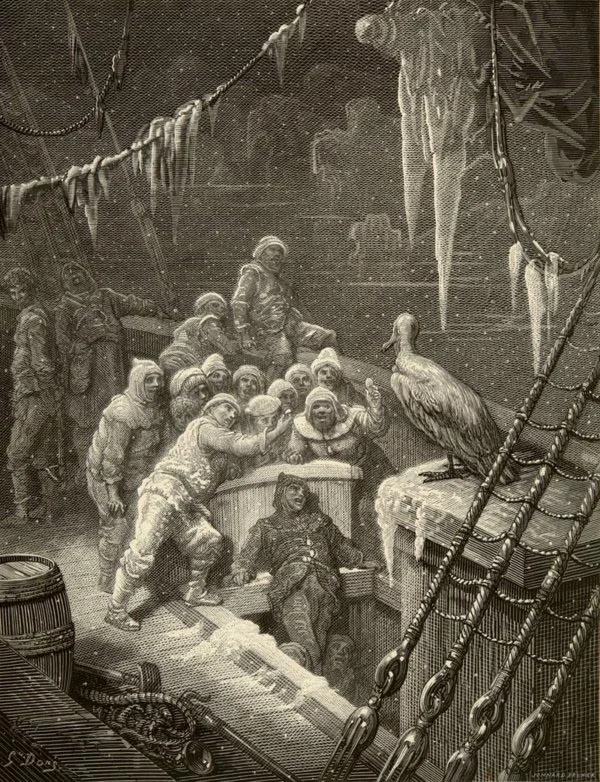
Through the snow, fog flies on the albatross
In this line, Harris pulls together threads from Coleridge’s poem –
At length did cross an Albatross,
Thorough the fog it came…
– and from his gloss on the poem:
Till a great sea-bird, called the Albatross, came through the snow-fog…
Coleridge makes an explicitly Christian reference –
As if it had been a Christian soul
We hail'd it in God's name…
– which Harris omits, saying only that the bird was “Hailed in God’s name” and continues “hoping good luck it brings”, which makes explicit something Coleridge refers too only obliquely by describing the ship’s positive progress after the albatross’s appearance:
The ice did split with a thunder-fit;
The helmsman steer'd us through!
And a good south wind sprung up behind…

Harris takes his description of the killing of the albatross from Coleridge’s gloss, which reads:
The ancient Mariner inhospitably killeth the pious bird of good omen.
Harris’s version paraphrases the gloss, while Coleridge’s poem, once again, fleshes it out, with the voice of the Wedding Guest breaking into the Mariner’s narrative:
‘God save thee, ancient Mariner!
From the fiends, that plague thee thus!
Why look'st thou so?'—'With my crossbow
I shot the Albatross’
The bald fact of the Mariner killing the albatross, with no mention of motive, is one of the most striking aspects of Coleridge’s poem. Harris, too, simply presents the fact, without comment: “The Mariner kills the bird of good omen.”
The crew’s fickleness, too, is shown in detail by Coleridge, their perceptions changing with the weather:
And I had done an hellish thing,
And it would work 'em woe:
For all averr'd, I had kill'd the bird
That made the breeze to blow.
Ah wretch! said they, the bird to slay,
That made the breeze to blow!
Nor dim nor red, like God's own head,
The glorious Sun uprist:
Then all averr'd, I had kill'd the bird
That brought the fog and mist.
'Twas right, said they, such birds to slay,
That bring the fog and mist.
Again, Harris draws on Coleridge’s gloss to show the reactions of the other shipmates, rendering this section as:
His shipmates cry against what he's done
But when the fog clears, they justify him
The consequence – that, by exonerating the Mariner at this point, they “make themselves a part of the crime” – is also from Coleridge’s moralising gloss, not from the poem, which merely describes, without passing judgment.
4. The Becalmed Ship

In his account of what happens next, Harris yet again follows Coleridge’s gloss, rather than the poem itself. In his fourth verse, he tells us “The albatross begins with its vengeance”. The idea that what happens to the ship and its crew is a form of revenge by the albatross is not expressed in the poem itself and is only mentioned in the gloss. As the ship becomes becalmed in the middle of the ocean, the crew once again turns against the Mariner, hanging the albatross around his neck as a sign of his guilt.
Sandwiching this verse are two short choruses of two lines each, each line containing the words “on and on”, like a refrain underscoring the inexorable unfolding of the narrative. These choruses are Harris’s own composition, thematically compatible, but not directly related to anything in Coleridge’s text.
And then he reproduces eight lines directly from Coleridge:
Day after day, day after day,
We stuck, nor breath nor motion;
As idle as a painted ship
Upon a painted ocean.
Water, water, everywhere,
And all the boards did shrink;
Water, water, everywhere,
Nor any drop to drink.
Since Harris is following Coleridge word for word here, these words come from the Mariner himself. He has, to an extent, paved the way for this in the last line of the two choruses – “And the thirst goes on and on for them and me” – where he creates a kind of identity between the narrator (i.e., the band’s vocalist, Bruce Dickinson, who delivers these words) and the crew. The ship is stuck, together with its crew, and the narrator thirsts along with them.
All of this is delivered to a driving beat, ostensibly quite at odds with the stillness of the scene depicted, yet somehow throwing that stillness into relief. Your mileage may vary, but I found that quite successful.
These are also some of the best-known lines in the poem; you may recognise them even if you’ve never read “The Ancient Mariner”. The repetition – “day after day”, “painted”, “water” – reinforces the sense of monotony and despair, as the crew are stuck in the limbo of a sailing ship with no wind, surrounded by the vast ocean.
5. The Ghost Ship

Harris describes a skeleton ship appearing on the horizon, approaching despite the absence of wind: “how can she sail with no wind in her sails and no tide?” he asks, following Coleridge’s gloss almost word for word.
On board are two figures – Death and Life-in-Death – who throw dice for the souls of the crew. Life-in-Death wins the Mariner; Death takes all the others. All of this is true to Coleridge’s text, though it is perhaps worth noting that, in the original 1798 version, “Life-in-Death” was not named.
It’s at this point that the tale goes beyond the natural and enters the realms of the supernatural. The ship sails with no wind, bringing its terrifying crew members, who play dice for the crew – Life-in-death winning the Mariner, and Death winning his shipmates.
In Coleridge’s text, night falls and the ghost ship shoots away as fast as had arrived (a detail Harris skips), and then the entire crew, apart from the Mariner, drops down dead. Once again, Harris reproduces eight lines directly from Coleridge’s poem:
One after one, by the star-dogg'd Moon,
Too quick for groan or sigh,
Each turn'd his face with a ghastly pang,
And cursed me with his eye.
Four times fifty living men
(And I heard nor sigh nor groan),
With heavy thump, a lifeless lump,
They dropp'd down one by one.
This time, though, Dickinson’s voice shifts from singing to speaking, against a deceptively gentle, but subtly ominous, melodic guitar background. Again, there seems to be a mismatch between the lyrics and the music, though it’s of a very different kind; here the drama of the men dying is in contrast with the softness of the music, which itself contrasts with the harsh beat of the rest of the song. But this apparent mismatch also works – at least, I think it does! I’m not really into heavy metal, so perhaps it was just the relief of a couple of minutes of something a bit gentler, but I think there’s more to it than that; the dramatic reading of those two stanzas carries real impact. For me, it’s the best part of the whole song.
6. Blessing the Water Snakes

The Mariner is alone with the dead. The curse, Harris tells us, “lives on in their eyes”. The mariner wishes he could die, but cannot. Then, by moonlight, he sees water snakes moving around the ship, trailing luminous colours through the dark water. “He prays for their beauty…he blesses them”, and, as he does so, the albatross falls from his neck and it finally rains.
Harris follows Coleridge quite closely here, but he omits several details. In particular, where Coleridge has the Mariner say – and repeat – “I bless'd them unaware”, Harris leaves out that word “unaware”.
That word “unaware” carries significant theological and psychological implications in the poem. The Mariner’s blessing is involuntary, not a conscious decision. Coleridge’s line, “A spring of love gushed from my heart”, suggests that the Mariner is saved by something over which he has no control, not by an intentional act of piety.
Harris’s version drops the word “unaware” entirely and adds an explicit reference to God and to prayer. I find this interesting, because, while he leaves a lot out, most of what he does include is true to the original poem. Here, though, he seems to change the message; rather than being saved by grace, the Mariner is saved by a deliberate act of piety.
7. The Dead Arise

It’s worth noting that, at this point, Coleridge is still less than halfway though his 626-line narrative, while Harris is only 22 lines from the end of his 66-line adaptation. Clearly, he’s going to have to leave a lot out!
In both versions – Coleridge’s and Harris’s – the dead crew members rise – not restored to life, but animated by angelic spirits who inhabit their bodies to work the sails. When I was first introduced to this poem, at the age of fourteen, it was this image of the dead sailors moving, zombie-like, that made the deepest impression on me.
Harris conveys this sequence in broad strokes. The “groans” of the dead sailors, the “good spirits” that raise up their bodies, their “lifeless” eyes – all these are true to Coleridge’s much more detailed account, in which the Virgin Mary sends sleep and (according to the gloss) rain to the Mariner, a wind makes the sails “sigh” and the moon shines at the edge of the black raincloud, while “lightning fell”.
But it is not the wind that drives the ship forward:
The loud wind never reach'd the ship,
Yet now the ship moved on!
Beneath the lightning and the Moon
The dead men gave a groan.
They groan'd, they stirr'd, they all uprose,
Nor spake, nor moved their eyes;
It had been strange, even in a dream,
To have seen those dead men rise.
The helmsman steer'd, the ship moved on;
Yet never a breeze up-blew;
The mariners all 'gan work the ropes,
Where they were wont to do;
They raised their limbs like lifeless tools—
We were a ghastly crew.
The body of my brother's son
Stood by me, knee to knee:
The body and I pull'd at one rope,
But he said naught to me.'
One of the strengths of Coleridge’s narrative structure is that it allows for interruptions to the Mariner’s tale, and here the Wedding Guest breaks in, with “I fear thee, ancient Mariner!”, which both anticipates the reactions of the reader and gives an opening for the Mariner to explain:
Twas not those souls that fled in pain,
Which to their corses came again,
But a troop of spirits blest…
8. The Mariner’s Trance

revenge still is sought, penance starts again
Cast into a trance, and the nightmare carries on
In these two lines, Harris summarises a complex section of Coleridge’s poem, in which the Mariner falls into a “swound” (i.e., a swoon) and hears two supernatural voices, adding a further layer of complexity to the poem’s narrative structure. Coleridge explains in the gloss that a “lonesome Spirit from the South Pole” has been carrying the ship as far as the equator. This spirit “still requireth vengeance”, but must now return to the Antarctic:
The Polar Spirit's fellow-demons, the invisible inhabitants of the element, take part in his wrong; and two of them relate, one to the other, that penance long and heavy for the ancient Mariner hath been accorded to the Polar Spirit, who returneth southward.
The Mariner awakes and still the ship is manned by its ghastly crew:
The pang, the curse, with which they died,
Had never pass'd away:
I could not draw my eyes from theirs,
Nor turn them up to pray.
There are several layers of the supernatural in Coleridge’s version, ranging from demons to angels, with both Christian and mythological elements. The poem is a treasure store of archetypal symbols and their psychological repercussions, but this section is perhaps the richest.
9. The Curse is Lifted

“And now this spell was snapt”, writes Coleridge – or, in Harris’s version – “the curse is finally lifted / And the Mariner sights his home”. At this point in the narrative, Coleridge gives us perhaps the most powerful lines in the whole poem. With the ship’s crew behind him, the mariner gazes ahead:
Like one that on a lonesome road
Doth walk in fear and dread,
And having once turn'd round, walks on,
And turns no more his head;
Because he knows a frightful fiend
Doth close behind him tread.
The Mariner sees the familiar landscape of his home harbour, and takes one last look at the crew, who are now once again lifeless – “Spirits go from the long-dead bodies”, in Harris’s words. A boat comes to meet the ship, carrying a Pilot, the Pilot’s son, and a Hermit. But as they approach, the ship suddenly sinks. The Mariner alone is rescued by the Pilot’s boat.
All this is sketched out in Harris’s lines, but, of course, we have to turn to Coleridge for the full picture, including the horrified reactions of the Mariner’s rescuers when he tries to speak and rows the boat:
I moved my lips—the Pilot shriek'd
And fell down in a fit;
The holy Hermit raised his eyes,
And pray'd where he did sit.
I took the oars: the Pilot's boy,
Who now doth crazy go,
Laugh'd loud and long, and all the while
His eyes went to and fro.
"Ha! ha!" quoth he, "full plain I see
The Devil knows how to row."
10. The Mariner’s Fate

Harris tells us “the Hermit shrieves the Mariner of his sins”, but the Mariner is “bound to tell of his story”:
To tell this tale wherever he goes
To teach God’s word by his own example
That we must love all things that God made
This is the moral of the tale, rendered by Coleridge as:
He prayeth best, who loveth best
All things both great and small;
For the dear God who loveth us,
He made and loveth all.
Many readers feel this is just a bit too pat; the crew of two hundred men have died, their bodies have been taken over by spirits, the Mariner himself has suffered and endured to the limits. Can this all be neatly tied up with a ribbon and presented as a homily on being kind to animals?
That’s the kind of thing you need to answer for yourself. Remember, it’s not what the poem means; it’s what it means to you. Whatever you take away from it is yours.
The illustrations used in this guide are taken from Gustave Doré’s series of engravings. If you found the enjoyed this guide, you may be interested in the interactive text and image version of the poem, which matches Coleridge’s text with Doré’s images.