
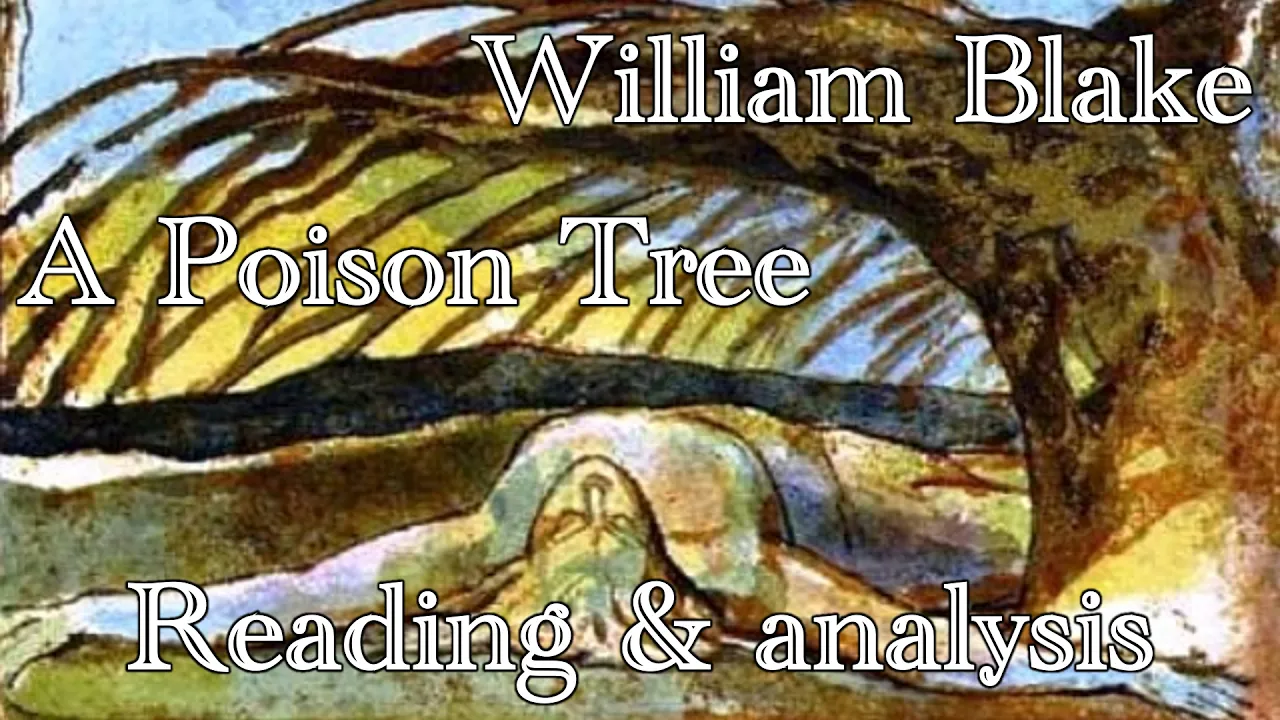
Author: Ano Sensei
Format: Video
Structure: Iambic, Rhyming couplets
Related content:
- • William Blake: Poetry – Reading & Analysis (Playlist) (Video Playlist)
- • William Blake: Vala, or The Four Zoas (Extract) – Reading (Video)
- • William Blake: The Human Abstract – Reading (Video)
- • William Blake: Never Seek to Tell Thy Love – Reading & Analysis (Video)
- • William Blake: The Tiger – Experimental Reading (Video)
William Blake, A poison tree. Reading and analysis Introduction to the poetry of William Blake #3
Building on the previous video (on "Never seek to tell thy love") I examine how Blake again contrasts telling (which ends things) with acting (which makes things grow). But this time the question is more troubling: should we express anger through action rather than words? The analysis considers Blake's support for the French Revolution, his praise of "tigers of wrath" in "The Marriage of Heaven and Hell," and his sympathy for Satan in the Garden of Eden story.
What's covered:
Telling vs expressing, words vs action (continued from previous video)
The conventional reading vs Blake's actual philosophy
Historical context: The French Revolution and Blake's politics
The Garden of Eden imagery and Blake's sympathy for Satan
Why the poem's ambiguity matters - great literature asks questions, not answers
Part of a series on Blake's philosophy of contraries. Follows "Never seek to tell thy love."
Who it's for:
Perfect for students studying Blake's Songs of Experience, A-Level/university literature courses, or anyone interested in how poems can resist simple moral interpretations.
0:00 Intro
0:10 A poison tree: A reading
1:10 Telling brings things to an end
1:20 Action vs telling
1:34 Ending and perpetuating anger
1:44 Telling as a negative quality
1:56 Telling in "A poison tree"
2:08 The narrator is glad about defeating a foe
2:18 Expressing one's feelings
2:31 A warning against repressed anger?
2:48 Expressing through action, not words
3:25 Expressing both positive and negative feelings
3:51 The French Revolution
4:10 "The tigers of wrath"
4:26 Necessary enmity
4:40 The Garden of Eden
4:52 Blake is on the side of Satan
5:10 Expressing anger
5:35 Conclusion: Ambiguity
In this third video in the series on Blake's poetry I look at an ambiguity at the heart of Blake's short poem "A poison tree". Is he warning the reader against repressing one's anger by not talking about it, or is he encouraging the reader to express anger through action? Or is it perhaps a bit of both?
I recommend you to watch these videos in order and, in particular, to watch the preceding video ("Never seek to tell your love" https://www.youtube.com/watch?v=vQtMDbUsOwY) before watching this one.
The first video in the series can be found here: https://youtu.be/WXBXodU5qKI
© All rights reserved
=========================================
I was angry with my friend;
I told my wrath, my wrath did end.
I was angry with my foe:
I told it not, my wrath did grow.
And I waterd it in fears,
Night & morning with my tears:
And I sunned it with smiles,
And with soft deceitful wiles.
And it grew both day and night.
Till it bore an apple bright.
And my foe beheld it shine,
And he knew that it was mine.
And into my garden stole,
When the night had veil'd the pole;
In the morning glad I see;
My foe outstretched beneath the tree.
#romanticpoetry #blake #williamblake #poisontree #naturepoem #naturepoetry #nature #poetry #poetryloversShow More
5 Comments
0:00 Intro
0:10 A poison tree: A reading
1:10 Telling brings things to an end
1:20 Action vs telling
1:34 Ending and perpetuating anger
1:44 Telling as a negative quality
1:56 Telling in “A poison tree”
2:08 The narrator is glad about defeating a foe
2:18 Expressing one’s feelings
2:31 A warning against repressed anger?
2:48 Expressing through action, not words
3:25 Expressing both positive and negative feelings
3:51 The French Revolution
4:10 “The tigers of wrath”
4:26 Necessary enmity
4:40 The Garden of Eden
4:52 Blake is on the side of Satan
5:10 Expressing anger
5:35 Conclusion: Ambiguity
The trap is humanity’s inability to do good. The link to the garden of Eden showing that eating from the tree of knowledge has led us nowhere as a species. We still are sinful and harbour bad deeds to our fellow men.
The beauty of poetry (and literature generally) lies, not so much in what it “means” as in what it means _to us_ . From that point of view, if this is what this poem means to you, then that is fine. I have to say, though, that Blake himself, while he believed in God, was highly critical of many aspects of Christianity, and I’m not sure that what you say here reflects his intentions in writing this poem!
I think it’s valid to see the apple and the tree as an allusion to the Garden of Eden and to place the poem in the context of human sin and moral failings. However, it seems to me that Blake is writing about the nature and effects of anger, rather than about humans’ general ability to do good. I feel we need to see what he says here in the context of statements like the following:
“Without contraries is no progression. Attraction and repulsion, reason and energy, love and hate, are necessary to human existence.
“From these contraries spring what the religious call Good and Evil. Good is the passive that obeys reason; Evil is the active springing from Energy.
“Good is heaven. Evil is hell.”
(William Blake, “The Marriage of Heaven and Hell”)
From this we can see that, for Blake, both good and evil and heaven and hell are “necessary to human existence”.
If you haven’t already done so, I would urge you to watch my other videos on Blake. The playlist link is here: https://www.youtube.com/playlist?list=PLzVb6yL_jY69kJRNsa_3wE54b8Tf8jp-b
I see the dualism within the poem, the contrasts of good and bad, harbouring hate and surface appearances, there are so many themes here and my analysis wasn’t meant to be definitive, just another way of seeing it, on top of what most people agree is there already.
Your quote from Heaven and Hell is a good example of Blake’s struggle with religion and the self. You made me think of the dark satanic mills in industrial England at the time of Blake and how that could be considered progress, to some people, and evil to others.
You are right about the difficulty of deconstructing being often down to interpretation and there is a danger of bringing something to a poem that isn’t there or intended by the author, especially if we can’t get the author’s final say.
I will look into your link, sounds interesting.
@timelanguid4813 You make a good point about the Industrial Revolution. Blake did stand in opposition to the way things were going, and decried the scientific method as “Newton’s sleep”, not so much as a Luddite as from the point of view of a defender of “vision” and “imagination”, which seemed to him to have no place in the scientific method and the rational philosophy of the Enlightenment.
Blake, like some of the other Romantics, sang the praises of the medieval Gothic, while at the same time decrying what he saw as the repressive stranglehold of the medieval Church, but this harking back to some kind of golden age of innocence and happiness seems to be a recurring feature of the human psyche. I came across a version of it recently in Yuval Noah Harari’s _Sapiens: A Brief History of Humankind_, who thinks the rot set in much earlier with the Agricultural Revolution, some 12,000 years ago.
You raise an interesting question when you speak of the “danger of bringing something to a poem that isn’t there or intended by the author”. The first is a valid point; sometimes our preconceptions prevent us from seeing what a poem or other work of literature is really about. I discuss this in one of my “Journey through poetry” videos (https://www.youtube.com/watch?v=w0IJ2_OSja8&list=PLzVb6yL_jY699zMtMVOzlYtxC7cJrnzgQ&index=3). The second relates to the “intentional fallacy”, a whole can of worms stemming from the question of whether what the poet or author thinks they are writing about should play any part in our apprehension of the finished result. This takes us right back to Plato, who says he talked to many poets and found they were the last people from whom one might get a fruitful insight into what they had written, concluding that they were essentially conduits for the muse that expressed itself through them.