
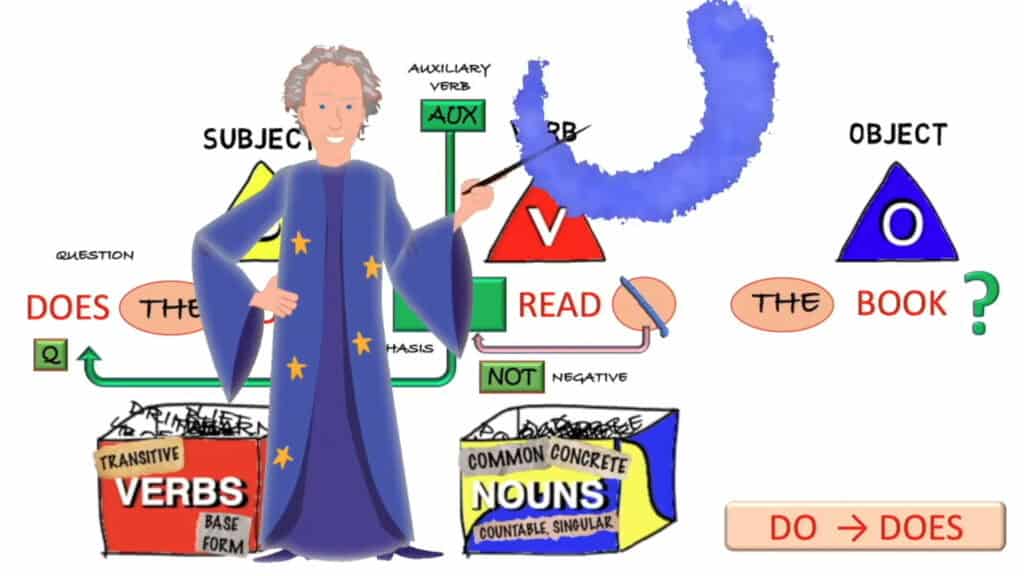
Don’t forget to check out Ano Sensei’s free course on Transformational Grammar for the language classroom! Just click on the image below.
For other content, pick something on the carousel, or scroll down and search/browse using the table menu.
Pick Something on the Carousel
Gone to or been to? What most textbooks get wrong | ENGLISH IN CONTEXT
Corrects the widespread textbook misconception that 'been to' always means 'gone and come back'. Explains...
I'll do what she tells me vs I'll tell you what she'll do | ENGLISH IN CONTEXT
Explains why 'will' appears once in 'I'll do what she tells me' but twice in 'I'll tell you what she'll...
And or so? Why your student's wrong answer might be right | ENGLISH IN CONTEXT
Uses a classroom quiz question about "and" vs "so" to illustrate how unspecified context leads teachers...
Spotlight on English: Advanced English Grammar
An advanced grammar series covering the present perfect and aspect, modal verbs, reported speech and...
You cannot say may you | or can you? Good and bad language teaching | ENGLISH IN CONTEXT
Uses the example of 'may you' to illustrate good and bad language teaching practice. Explains the correct...
English in Context: Basic English Grammar
A grammar series teaching English in context at intermediate level, covering reported speech and backshift,...
"If I knew, I would tell you" or "I would have told you"? Mixed conditionals | ENGLISH IN CONTEXT
Introduces mixed conditionals — constructions that combine elements from different time frames —...
The passive voice: knowing how to make it is not enough | ENGLISH IN CONTEXT
Explains why teaching only how to form the passive voice is insufficient. Introduces the principle that...
I'm glad you can come or I'm glad you could come | ENGLISH IN CONTEXT
Examines the difference between 'I'm glad you can come' and 'I'm glad you could come', showing how the...
Do you always need backshift in reported speech? ENGLISH IN CONTEXT
An examination of backshift in reported speech, explaining when it is required and when it is optional....
Do you go or will you go? Zero vs first conditional | ENGLISH IN CONTEXT
Explores the overlap between the zero and first conditional, showing that the zero conditional can be...
She answered every question correctly and still failed the test | ENGLISH IN CONTEXT
A listening comprehension exercise in which a student answers every question correctly and still fails...
It hasn't rained or hasn't been raining for a week | both correct? ENGLISH IN CONTEXT
Explains why both 'it hasn't rained for a week' and 'it hasn't been raining for a week' are grammatically...
Have studied or have been studying? Why your textbook may be wrong | ENGLISH IN CONTEXT
Examines a group of verbs (live, work, study, teach, speak) for which the present perfect simple and...
Curated Grammar Livestream: Your Questions Answered
A curated playlist of grammar livestreams answering learner questions on a wide range of topics including...