
Author: Ano Sensei
Format: Video
Related content:
- • I’m glad you can come or I’m glad you could come | ENGLISH IN CONTEXT (Video)
- • Curated Grammar Livestream: Your Questions Answered (Video Playlist)
- • English in Context: Basic English Grammar (Video Playlist)
- • Curated Grammar Livestream: Your Questions Answered (Video Playlist)
- • Spotlight on English: Advanced English Grammar (Video Playlist)
📚 Part of a series: English in Context: Basic English Grammar
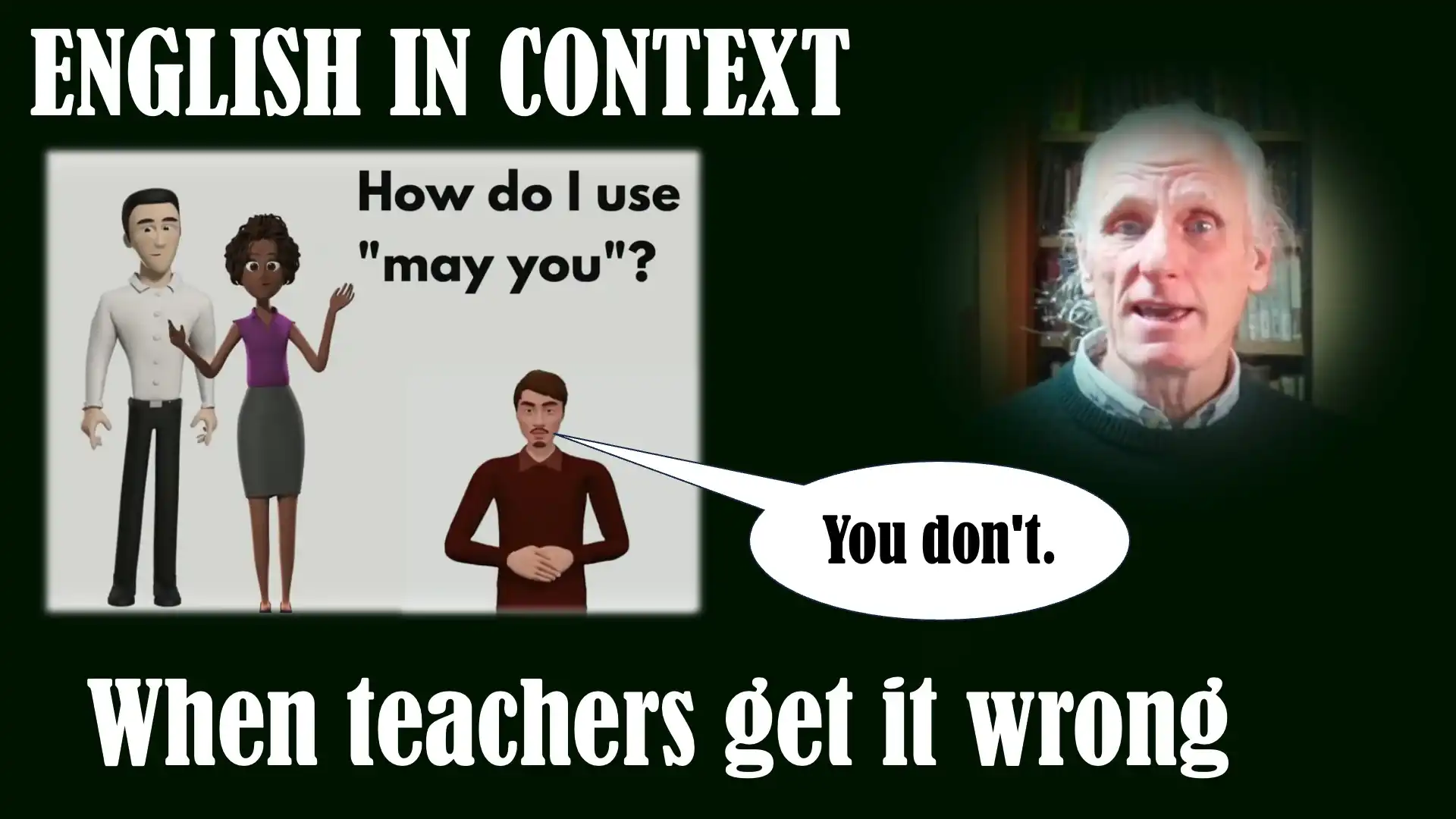
🧑🎓 "You can't say 'may you'" — or can you? Good & bad language teaching | ENGLISH IN CONTEXT 👀
In this video I use the example of "may you" to illustrate one of the differences between good and bad language teaching. "May you" is a perfectly valid English construction — but only in specific contexts. It's used when expressing a wish or hope directed at another person ("May you have a long and happy life"), and with wh- words in a wondering or speculative sense ("What may you find?"). A teacher who only thinks of "may" in terms of asking permission will tell students it doesn't exist — and be wrong.
The broader point is simple, and it runs through this entire series: before telling a student that an expression is wrong, think carefully about all the contexts in which it could be used. The expression may be wrong in the context you have in mind — but perfectly correct in another. This is something any teacher can do, without specialist linguistic training. It just requires the habit of asking: is there a context in which this would work?
What this video covers:
When and how "may you" is used in English
The difference between "may" for permission and "may" for wishes and hopes
How "may you" works with wh- words
Why teachers who only consider one context give incomplete — or incorrect — answers
A practical principle for better language teaching
I'm John R. Yamamoto-Wilson — formerly Professor of English Literature at Sophia University, Tokyo, with a PhD from the University of Cambridge. These videos are aimed at intermediate learners of English, and at the teachers who work with them. 📌 Part of the English in Context series — intermediate grammar points that textbooks often explain poorly or get wrong. Click here for the complete series: https://www.youtube.com/playlist?list=PLzVb6yL_jY6_sKngAN_gYB8w-KC20AGP4
© All rights reservedShow More