
Author: Ano Sensei
Format: Video Playlist
Subject Matter: any, backshift, common errors, conditionals, conjunctions, context, descriptive grammar, determiners, mixed conditionals, modal verbs, passive voice, present perfect, reported speech, some
Related content:
- • “If I knew, I would tell you” or “I would have told you”? Mixed conditionals | ENGLISH IN CONTEXT (Video)
- • “Some” or “any”? The rule your textbook gets wrong 20% of the time | ENGLISH IN CONTEXT (Video)
- • The passive voice: knowing how to make it is not enough | ENGLISH IN CONTEXT (Video)
- • You cannot say may you | or can you? Good and bad language teaching | ENGLISH IN CONTEXT (Video)
- • And or so? Why your student’s wrong answer might be right | ENGLISH IN CONTEXT (Video)
🧑🎓Will have done / have done / had done: what's the difference? Present past and future perfect 👀
In this video I use a single story ...to explain all three perfect tenses — past, present and future — and show you exactly when and why we use them instead of ordinary past, present and future tenses.
By the end you'll understand the difference between sentences like these:
'The wheels have been replaced' (present perfect)
'The wheels had been replaced' (past perfect)
'The wheels will have been replaced' (future perfect)
And you'll have a good grasp on why each one is the right choice in its context.
© All rights reservedShow More

Now Playing
🧑🎓Will have done / have done / had done: what's the difference? Present past and future perfect 👀
Do you find the perfect tenses confusing? You're not alone — but ...
Do you find the perfect tenses confusing? You're not alone — but they're simpler than you think once you understand the underlying logic.
In this video I use a single story ...to explain all three perfect tenses — past, present and future — and show you exactly when and why we use them instead of ordinary past, present and future tenses.
By the end you'll understand the difference between sentences like these:
'The wheels have been replaced' (present perfect)
'The wheels had been replaced' (past perfect)
'The wheels will have been replaced' (future perfect)
And you'll have a good grasp on why each one is the right choice in its context.
© All rights reservedShow More
In this video I use a single story ...to explain all three perfect tenses — past, present and future — and show you exactly when and why we use them instead of ordinary past, present and future tenses.
By the end you'll understand the difference between sentences like these:
'The wheels have been replaced' (present perfect)
'The wheels had been replaced' (past perfect)
'The wheels will have been replaced' (future perfect)
And you'll have a good grasp on why each one is the right choice in its context.
© All rights reservedShow More

Now Playing
🧑🎓I've had lunch, but I'm still hungry! What textbooks get wrong about the present perfect tense 👀
Have you ever been told that 'I've had lunch' means you're not hungry ...
Have you ever been told that 'I've had lunch' means you're not hungry any more? That's one of the many misleading explanations you'll often find in English textbooks. In this ...video I explain the real difference between the present perfect and the past simple — and why it's simpler than most textbooks make it seem.
This is Part One of a short series comparing the present perfect with the past simple:
Part One: Past event, present effect (this video)
Part Two: Negative situations https://youtu.be/o5rKTe__Tng
Part Three: Ongoing situations"
Complete perfect forms of the verb playlist: https://www.youtube.com/playlist?list=PLzVb6yL_jY6_x_BlR_i4UjiW6DB1XRPM_
Subscribe to the "Ano sensei" English language playlist for more useful tips about learning English: https://www.youtube.com/watch?v=kooSTIMNYrg&list=PLzVb6yL_jY6_y40eAlbaPEQ2Yq7eoA2HB
© All rights reservedShow More
This is Part One of a short series comparing the present perfect with the past simple:
Part One: Past event, present effect (this video)
Part Two: Negative situations https://youtu.be/o5rKTe__Tng
Part Three: Ongoing situations"
Complete perfect forms of the verb playlist: https://www.youtube.com/playlist?list=PLzVb6yL_jY6_x_BlR_i4UjiW6DB1XRPM_
Subscribe to the "Ano sensei" English language playlist for more useful tips about learning English: https://www.youtube.com/watch?v=kooSTIMNYrg&list=PLzVb6yL_jY6_y40eAlbaPEQ2Yq7eoA2HB
© All rights reservedShow More

Now Playing
🧑🎓 I didn't do my homework' vs 'I haven't done my homework' — is there a difference? 👀
"Is there a difference between 'I didn't do my homework' and 'I ...
"Is there a difference between 'I didn't do my homework' and 'I haven't done my homework'? Many learners think these mean the same thing — but they don't.
In this second ...video in my present perfect series, I show how the present perfect carries an implied future meaning that the past simple doesn't. When Zane says 'I haven't done my homework', he's suggesting he still might do it. When he says 'I didn't do my homework', that possibility feels closed.
This subtle difference matters in everyday English — and once you see it, you'll notice it everywhere.
This is Part Two of a short series comparing the present perfect with the past simple:
Part One: Past event, present effect https://youtu.be/NUt03lajq30
Part Two: Negative situations (this video) https://youtu.be/o5rKTe__Tng
Part Three: Ongoing situations"
Complete perfect forms of the verb playlist: https://www.youtube.com/playlist?list=PLzVb6yL_jY6_x_BlR_i4UjiW6DB1XRPM_
Subscribe to the "Ano sensei" English language playlist for more useful tips about learning English: https://www.youtube.com/watch?v=kooSTIMNYrg&list=PLzVb6yL_jY6_y40eAlbaPEQ2Yq7eoA2HB
© All rights reservedShow More
In this second ...video in my present perfect series, I show how the present perfect carries an implied future meaning that the past simple doesn't. When Zane says 'I haven't done my homework', he's suggesting he still might do it. When he says 'I didn't do my homework', that possibility feels closed.
This subtle difference matters in everyday English — and once you see it, you'll notice it everywhere.
This is Part Two of a short series comparing the present perfect with the past simple:
Part One: Past event, present effect https://youtu.be/NUt03lajq30
Part Two: Negative situations (this video) https://youtu.be/o5rKTe__Tng
Part Three: Ongoing situations"
Complete perfect forms of the verb playlist: https://www.youtube.com/playlist?list=PLzVb6yL_jY6_x_BlR_i4UjiW6DB1XRPM_
Subscribe to the "Ano sensei" English language playlist for more useful tips about learning English: https://www.youtube.com/watch?v=kooSTIMNYrg&list=PLzVb6yL_jY6_y40eAlbaPEQ2Yq7eoA2HB
© All rights reservedShow More

Now Playing
🧑🎓 "I've lived in France for ten years" — but he's in South Africa! Present perfect explained 👀
ENGLISH GRAMMAR: VERB TENSE. This is the third video in a short series ...
ENGLISH GRAMMAR: VERB TENSE. This is the third video in a short series comparing and contrasting the present perfect tense with the past simple tense.
In this video I look at ...situations which continued in the past, but have finished now, and situations which began in the past and still continue. For a detailed explanation of the difference between "have lived" and "have been living", check here: https://www.youtube.com/watch?v=ZZvHkDYbNh8
This is Part Three of a short series comparing the present perfect with the past simple:
Part One: Past event, present effect https://youtu.be/NUt03lajq30
Part Two: Negative situations https://youtu.be/o5rKTe__Tng
Part Three: Ongoing situations (this video)
Complete perfect forms of the verb playlist: https://www.youtube.com/playlist?list=PLzVb6yL_jY6_x_BlR_i4UjiW6DB1XRPM_
Subscribe to the "Ano sensei" English language playlist for more useful tips about learning English: https://www.youtube.com/watch?v=kooSTIMNYrg&list=PLzVb6yL_jY6_y40eAlbaPEQ2Yq7eoA2HB
© All rights reservedShow More
In this video I look at ...situations which continued in the past, but have finished now, and situations which began in the past and still continue. For a detailed explanation of the difference between "have lived" and "have been living", check here: https://www.youtube.com/watch?v=ZZvHkDYbNh8
This is Part Three of a short series comparing the present perfect with the past simple:
Part One: Past event, present effect https://youtu.be/NUt03lajq30
Part Two: Negative situations https://youtu.be/o5rKTe__Tng
Part Three: Ongoing situations (this video)
Complete perfect forms of the verb playlist: https://www.youtube.com/playlist?list=PLzVb6yL_jY6_x_BlR_i4UjiW6DB1XRPM_
Subscribe to the "Ano sensei" English language playlist for more useful tips about learning English: https://www.youtube.com/watch?v=kooSTIMNYrg&list=PLzVb6yL_jY6_y40eAlbaPEQ2Yq7eoA2HB
© All rights reservedShow More

Now Playing
🧑🎓 Why do we need past perfect? Why not just use the past simple? Ano sensei explains. 👀
The past perfect is often described as being the tense we use when one ...
The past perfect is often described as being the tense we use when one thing happens before something else in the past. But there's more to it than that. Ano ...sensei explains...
© All rights reservedShow More
© All rights reservedShow More

Now Playing
🧑🎓I'll do what she tells me /I'll tell you what she'll do: the future future! | ENGLISH IN CONTEXT👀
"I'll do what she tells me" uses "will" once. "I'll tell you what ...
"I'll do what she tells me" uses "will" once. "I'll tell you what she'll do" uses it twice. Why? And why can't you say "I will do what she will ...tell me"?
In this video I explain the concept of "the future in the future" — what happens when a sentence about the future also contains a reference to something that will happen even further ahead. It's a distinction that puzzles many learners, and one that most textbooks handle poorly if at all.
The key difference: in "I'll do what she tells me", "will" puts the whole situation into the future — her instructions will come as present-tense commands ("Wash the car!", "Phone your mother!"). But in "I'll tell you what she'll do", the first "will" places the speaker in the future, and the second "will" pushes what she does to a point even further ahead — the future in the future.
For a more detailed explanation covering a wider range of dependent clauses with a future meaning, see the follow-up video: https://youtu.be/BHOEZxp2a1o?feature=shared
What this video covers:
Why "will" appears once in "I'll do what she tells me" but twice in "I'll tell you what she'll do"
Why "I will do what she will tell me" is incorrect
The concept of "the future in the future" in English grammar
How "will" behaves differently in different types of dependent clause
I'm John R. Yamamoto-Wilson — formerly Professor of English Literature at Sophia University, Tokyo, with a PhD from the University of Cambridge. These videos are aimed at intermediate learners of English, and at the teachers who work with them. 📌 Part of the English in Context series — intermediate grammar points that textbooks often explain poorly or get wrong. Click here for the complete series: https://www.youtube.com/playlist?list=PLzVb6yL_jY6_sKngAN_gYB8w-KC20AGP4
© All rights reservedShow More
In this video I explain the concept of "the future in the future" — what happens when a sentence about the future also contains a reference to something that will happen even further ahead. It's a distinction that puzzles many learners, and one that most textbooks handle poorly if at all.
The key difference: in "I'll do what she tells me", "will" puts the whole situation into the future — her instructions will come as present-tense commands ("Wash the car!", "Phone your mother!"). But in "I'll tell you what she'll do", the first "will" places the speaker in the future, and the second "will" pushes what she does to a point even further ahead — the future in the future.
For a more detailed explanation covering a wider range of dependent clauses with a future meaning, see the follow-up video: https://youtu.be/BHOEZxp2a1o?feature=shared
What this video covers:
Why "will" appears once in "I'll do what she tells me" but twice in "I'll tell you what she'll do"
Why "I will do what she will tell me" is incorrect
The concept of "the future in the future" in English grammar
How "will" behaves differently in different types of dependent clause
I'm John R. Yamamoto-Wilson — formerly Professor of English Literature at Sophia University, Tokyo, with a PhD from the University of Cambridge. These videos are aimed at intermediate learners of English, and at the teachers who work with them. 📌 Part of the English in Context series — intermediate grammar points that textbooks often explain poorly or get wrong. Click here for the complete series: https://www.youtube.com/playlist?list=PLzVb6yL_jY6_sKngAN_gYB8w-KC20AGP4
© All rights reservedShow More
Now Playing
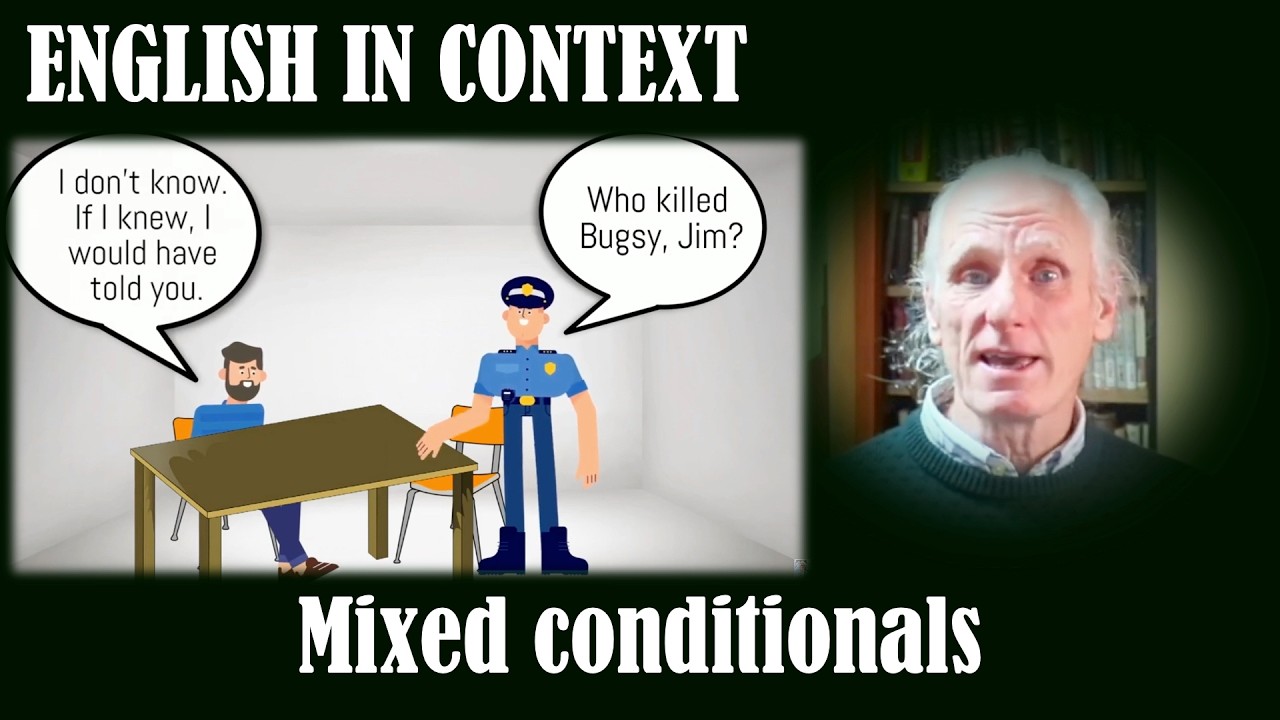
🧑🎓"If I knew, I would tell you" or "I would have told you"? Mixed conditionals ENGLISH IN CONTEXT👀
"If I knew, I would tell you" — or "If I knew, I would have told you"? ...
"If I knew, I would tell you" — or "If I knew, I would have told you"? Most learners would reach for the first. But the second is also correct, ...and it means something quite different.
Students typically learn the first, second and third conditionals, and perhaps the zero conditional. What most textbooks don't cover is the range of mixed conditionals — constructions that combine elements from different time frames. In this video I use a detective scenario to show how "If I knew, I would have told you" mixes a present condition (I don't know now) with a past result (I would already have told you before now). That's a genuinely different meaning from either the standard second or third conditional — and it's the kind of thing that real language does all the time.
The video also touches on the connection between mixed conditionals and backshift in reported speech, and on the fact that native speakers don't always follow the rules taught in the classroom.
For more on related topics: https://youtu.be/UG1c09rNAXM and https://youtu.be/o0kkmbg2N9M
What this video covers:
The standard second and third conditionals and what they express
How "If I knew, I would have told you" creates a mixed conditional
The three constructions compared: present/future, fully past, and mixed
The connection between mixed conditionals and backshift in reported speech
Why real language doesn't always follow textbook rules
I'm John R. Yamamoto-Wilson — formerly Professor of English Literature at Sophia University, Tokyo, with a PhD from the University of Cambridge. These videos are aimed at intermediate learners of English, and at the teachers who work with them. 📌 Part of the English in Context series — intermediate grammar points that textbooks often explain poorly or get wrong. Click here for the complete series: https://www.youtube.com/playlist?list=PLzVb6yL_jY6_sKngAN_gYB8w-KC20AGP4
© All rights reservedShow More
Students typically learn the first, second and third conditionals, and perhaps the zero conditional. What most textbooks don't cover is the range of mixed conditionals — constructions that combine elements from different time frames. In this video I use a detective scenario to show how "If I knew, I would have told you" mixes a present condition (I don't know now) with a past result (I would already have told you before now). That's a genuinely different meaning from either the standard second or third conditional — and it's the kind of thing that real language does all the time.
The video also touches on the connection between mixed conditionals and backshift in reported speech, and on the fact that native speakers don't always follow the rules taught in the classroom.
For more on related topics: https://youtu.be/UG1c09rNAXM and https://youtu.be/o0kkmbg2N9M
What this video covers:
The standard second and third conditionals and what they express
How "If I knew, I would have told you" creates a mixed conditional
The three constructions compared: present/future, fully past, and mixed
The connection between mixed conditionals and backshift in reported speech
Why real language doesn't always follow textbook rules
I'm John R. Yamamoto-Wilson — formerly Professor of English Literature at Sophia University, Tokyo, with a PhD from the University of Cambridge. These videos are aimed at intermediate learners of English, and at the teachers who work with them. 📌 Part of the English in Context series — intermediate grammar points that textbooks often explain poorly or get wrong. Click here for the complete series: https://www.youtube.com/playlist?list=PLzVb6yL_jY6_sKngAN_gYB8w-KC20AGP4
© All rights reservedShow More
Now Playing
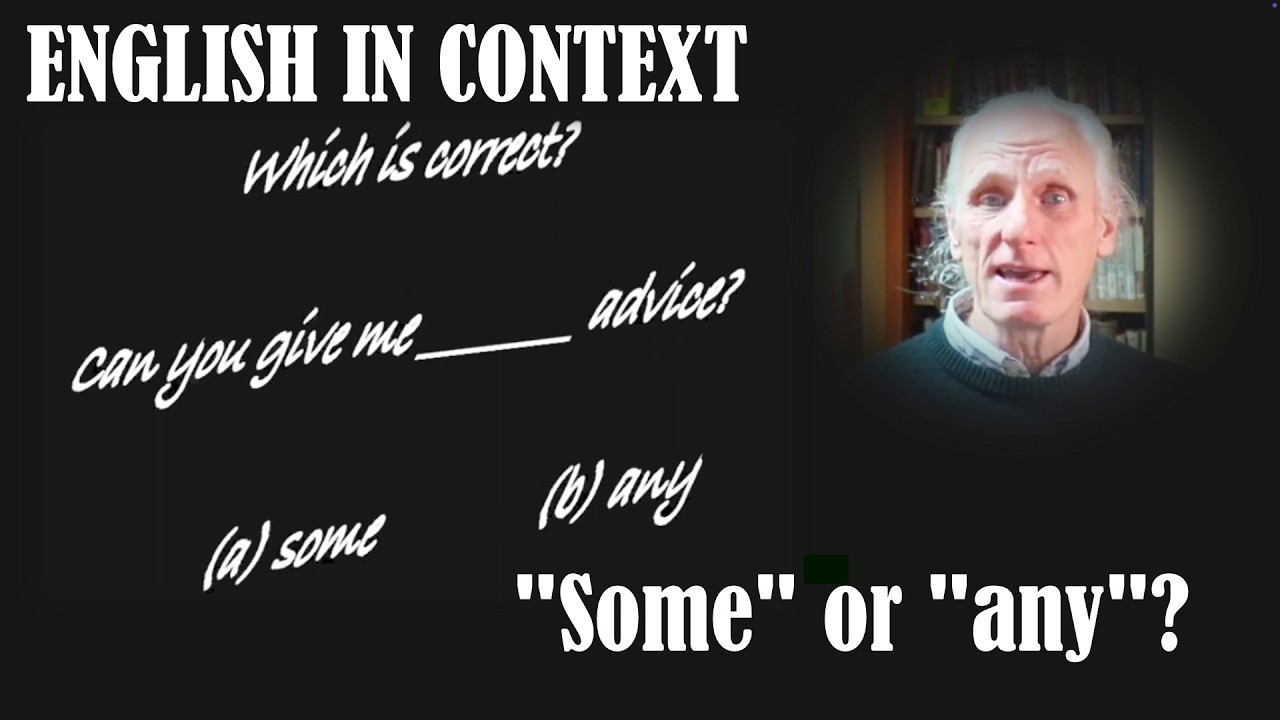
🧑🎓 "Some" or "any"? The rule your textbook gets wrong 20% of the time | ENGLISH IN CONTEXT 👀
"Can you give me some advice" or "can you give me any advice"? Most ...
"Can you give me some advice" or "can you give me any advice"? Most learners know the English grammar rule: "some" for positive statements, "any" for questions and negatives. The ...problem is that rule breaks down roughly 20% of the time. This video gives a basic English grammar guide for these English quantifiers.
Consider: "Could I have some coffee, please?" — a question, but "some" is required. "Any coffee will be fine" — a positive statement, but "any" is correct. The simple rule fails both. A better approach is to think about what "some" and "any" actually mean: we use "some" when we have a particular thing in mind, and "any" when it doesn't matter which one. Once you understand that distinction, the apparent exceptions stop being exceptions.
For a more detailed explanation, see the follow-up video: https://youtu.be/2aHoPOa0XgI
What this video covers:
The standard "some/any" rule and why it works most but not all of the time
Examples where the rule breaks down
A better way to think about "some" and "any": specific vs. non-specific
Why context — and how the speaker thinks about the situation — determines the choice
I'm John R. Yamamoto-Wilson — formerly Professor of English Literature at Sophia University, Tokyo, with a PhD from the University of Cambridge. These videos are aimed at intermediate learners of English, and at the teachers who work with them. 📌 Part of the English in Context series — intermediate grammar points that textbooks often explain poorly or get wrong. Click here for the complete series: https://www.youtube.com/playlist?list=PLzVb6yL_jY6_sKngAN_gYB8w-KC20AGP4
© All rights reservedShow More
Consider: "Could I have some coffee, please?" — a question, but "some" is required. "Any coffee will be fine" — a positive statement, but "any" is correct. The simple rule fails both. A better approach is to think about what "some" and "any" actually mean: we use "some" when we have a particular thing in mind, and "any" when it doesn't matter which one. Once you understand that distinction, the apparent exceptions stop being exceptions.
For a more detailed explanation, see the follow-up video: https://youtu.be/2aHoPOa0XgI
What this video covers:
The standard "some/any" rule and why it works most but not all of the time
Examples where the rule breaks down
A better way to think about "some" and "any": specific vs. non-specific
Why context — and how the speaker thinks about the situation — determines the choice
I'm John R. Yamamoto-Wilson — formerly Professor of English Literature at Sophia University, Tokyo, with a PhD from the University of Cambridge. These videos are aimed at intermediate learners of English, and at the teachers who work with them. 📌 Part of the English in Context series — intermediate grammar points that textbooks often explain poorly or get wrong. Click here for the complete series: https://www.youtube.com/playlist?list=PLzVb6yL_jY6_sKngAN_gYB8w-KC20AGP4
© All rights reservedShow More
Now Playing
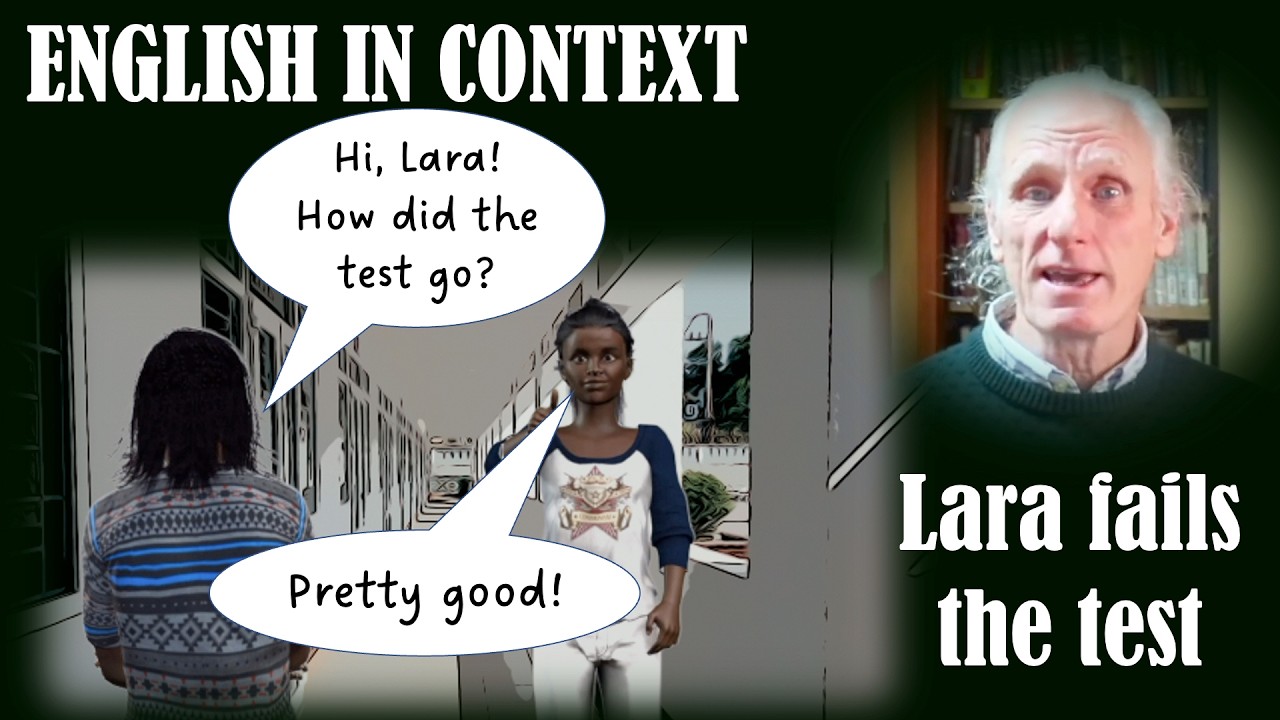
🧑🎓 She answered every question correctly — and still failed the test | ENGLISH IN CONTEXT 👀
Lara listened carefully. She understood every word of the passage. She ...
Lara listened carefully. She understood every word of the passage. She answered every single question correctly. And she still failed the test.
But why?
This video is a little different from the ...others in the series — I'm leaving the explanation almost entirely to you. Listen to the passage, answer the three questions, and see if you spot what went wrong before Lara's answers are revealed. It makes a serious point about how test questions can go wrong, but it does so in a way that's hard to forget.
What this video covers:
A short listening comprehension passage with three questions
A student who gets every answer right — and fails
Whose fault is it? The student's? The teacher's? The examiner setting the test?
A subtle but important point about how "or" questions work in English
I'm John R. Yamamoto-Wilson — formerly Professor of English Literature at Sophia University, Tokyo, with a PhD from the University of Cambridge. These videos are aimed at intermediate learners of English, and at the teachers who work with them. 📌 Part of the English in Context series — intermediate grammar points that textbooks often explain poorly or get wrong. Click here for the complete series: https://www.youtube.com/playlist?list=PLzVb6yL_jY6_sKngAN_gYB8w-KC20AGP4
© All rights reservedShow More
But why?
This video is a little different from the ...others in the series — I'm leaving the explanation almost entirely to you. Listen to the passage, answer the three questions, and see if you spot what went wrong before Lara's answers are revealed. It makes a serious point about how test questions can go wrong, but it does so in a way that's hard to forget.
What this video covers:
A short listening comprehension passage with three questions
A student who gets every answer right — and fails
Whose fault is it? The student's? The teacher's? The examiner setting the test?
A subtle but important point about how "or" questions work in English
I'm John R. Yamamoto-Wilson — formerly Professor of English Literature at Sophia University, Tokyo, with a PhD from the University of Cambridge. These videos are aimed at intermediate learners of English, and at the teachers who work with them. 📌 Part of the English in Context series — intermediate grammar points that textbooks often explain poorly or get wrong. Click here for the complete series: https://www.youtube.com/playlist?list=PLzVb6yL_jY6_sKngAN_gYB8w-KC20AGP4
© All rights reservedShow More

Now Playing
🧑🎓 The passive voice: knowing how to make it isn't enough | ENGLISH IN CONTEXT 👀
Most learners of English get taught how to make the passive voice. ...
Most learners of English get taught how to make the passive voice. Very few get taught why we use it. And that's where the problems start.
"I have a pet dog ...— so 'A pet dog is had by me', right?" Grammatically, the construction follows the rule perfectly. But no native speaker would say it. Why not? And how do you explain that to a student who did exactly what the textbook said?
In this video I look at the real reason we use the passive in English: we use it to talk about what is happening TO someone or something — when the subject is genuinely being acted upon. "Having" a dog doesn't involve anything happening to the dog. Clothes don't act on you the way a teacher acts on a student. Once you understand this principle, the grammatically-correct-but-wrong passives start to make sense — and so does the rule that actually governs when the passive works.
This is the introductory video in a series on the passive voice. For a more detailed treatment, see the follow-up video: https://www.youtube.com/watch?v=Js9phw4Js64&list=PLzVb6yL_jY6-J70nxQ5fs1F8ACC8x80AQ&index=2
What this video covers:
Why teaching only how to form the passive leaves learners stuck
The real reason we use the passive: talking about what happens TO someone or something
Why "A pet dog is had by me" is grammatically correct but still wrong
A more accurate rule for when passive subjects work and when they don't
Why native speakers are often just told "don't use the passive" — and why that's unhelpful
I'm John R. Yamamoto-Wilson — formerly Professor of English Literature at Sophia University, Tokyo, with a PhD from the University of Cambridge. These videos are aimed at intermediate learners of English, and at the teachers who work with them. 📌 Part of the English in Context series — intermediate grammar points that textbooks often explain poorly or get wrong. Click here for the complete series: https://www.youtube.com/playlist?list=PLzVb6yL_jY6_sKngAN_gYB8w-KC20AGP4
© All rights reservedShow More
"I have a pet dog ...— so 'A pet dog is had by me', right?" Grammatically, the construction follows the rule perfectly. But no native speaker would say it. Why not? And how do you explain that to a student who did exactly what the textbook said?
In this video I look at the real reason we use the passive in English: we use it to talk about what is happening TO someone or something — when the subject is genuinely being acted upon. "Having" a dog doesn't involve anything happening to the dog. Clothes don't act on you the way a teacher acts on a student. Once you understand this principle, the grammatically-correct-but-wrong passives start to make sense — and so does the rule that actually governs when the passive works.
This is the introductory video in a series on the passive voice. For a more detailed treatment, see the follow-up video: https://www.youtube.com/watch?v=Js9phw4Js64&list=PLzVb6yL_jY6-J70nxQ5fs1F8ACC8x80AQ&index=2
What this video covers:
Why teaching only how to form the passive leaves learners stuck
The real reason we use the passive: talking about what happens TO someone or something
Why "A pet dog is had by me" is grammatically correct but still wrong
A more accurate rule for when passive subjects work and when they don't
Why native speakers are often just told "don't use the passive" — and why that's unhelpful
I'm John R. Yamamoto-Wilson — formerly Professor of English Literature at Sophia University, Tokyo, with a PhD from the University of Cambridge. These videos are aimed at intermediate learners of English, and at the teachers who work with them. 📌 Part of the English in Context series — intermediate grammar points that textbooks often explain poorly or get wrong. Click here for the complete series: https://www.youtube.com/playlist?list=PLzVb6yL_jY6_sKngAN_gYB8w-KC20AGP4
© All rights reservedShow More
Now Playing
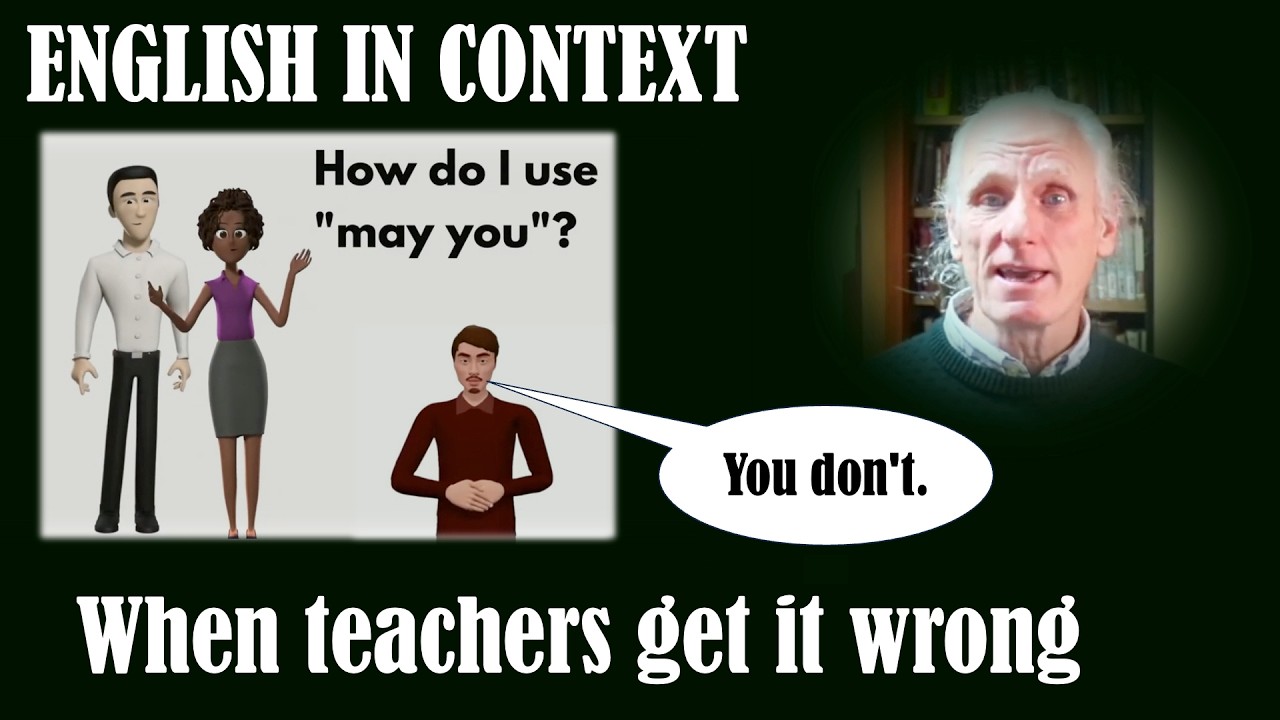
🧑🎓 "You can't say 'may you'" — or can you? Good & bad language teaching | ENGLISH IN CONTEXT 👀
"You can't say 'may you'." That's what the teacher says. Then a ...
"You can't say 'may you'." That's what the teacher says. Then a student mentions a song: "May you walk in sunlight shining." And suddenly the teacher changes his mind. So ...which is it?
In this video I use the example of "may you" to illustrate one of the differences between good and bad language teaching. "May you" is a perfectly valid English construction — but only in specific contexts. It's used when expressing a wish or hope directed at another person ("May you have a long and happy life"), and with wh- words in a wondering or speculative sense ("What may you find?"). A teacher who only thinks of "may" in terms of asking permission will tell students it doesn't exist — and be wrong.
The broader point is simple, and it runs through this entire series: before telling a student that an expression is wrong, think carefully about all the contexts in which it could be used. The expression may be wrong in the context you have in mind — but perfectly correct in another. This is something any teacher can do, without specialist linguistic training. It just requires the habit of asking: is there a context in which this would work?
What this video covers:
When and how "may you" is used in English
The difference between "may" for permission and "may" for wishes and hopes
How "may you" works with wh- words
Why teachers who only consider one context give incomplete — or incorrect — answers
A practical principle for better language teaching
I'm John R. Yamamoto-Wilson — formerly Professor of English Literature at Sophia University, Tokyo, with a PhD from the University of Cambridge. These videos are aimed at intermediate learners of English, and at the teachers who work with them. 📌 Part of the English in Context series — intermediate grammar points that textbooks often explain poorly or get wrong. Click here for the complete series: https://www.youtube.com/playlist?list=PLzVb6yL_jY6_sKngAN_gYB8w-KC20AGP4
© All rights reservedShow More
In this video I use the example of "may you" to illustrate one of the differences between good and bad language teaching. "May you" is a perfectly valid English construction — but only in specific contexts. It's used when expressing a wish or hope directed at another person ("May you have a long and happy life"), and with wh- words in a wondering or speculative sense ("What may you find?"). A teacher who only thinks of "may" in terms of asking permission will tell students it doesn't exist — and be wrong.
The broader point is simple, and it runs through this entire series: before telling a student that an expression is wrong, think carefully about all the contexts in which it could be used. The expression may be wrong in the context you have in mind — but perfectly correct in another. This is something any teacher can do, without specialist linguistic training. It just requires the habit of asking: is there a context in which this would work?
What this video covers:
When and how "may you" is used in English
The difference between "may" for permission and "may" for wishes and hopes
How "may you" works with wh- words
Why teachers who only consider one context give incomplete — or incorrect — answers
A practical principle for better language teaching
I'm John R. Yamamoto-Wilson — formerly Professor of English Literature at Sophia University, Tokyo, with a PhD from the University of Cambridge. These videos are aimed at intermediate learners of English, and at the teachers who work with them. 📌 Part of the English in Context series — intermediate grammar points that textbooks often explain poorly or get wrong. Click here for the complete series: https://www.youtube.com/playlist?list=PLzVb6yL_jY6_sKngAN_gYB8w-KC20AGP4
© All rights reservedShow More

Now Playing
🧑🎓 "And" or "so"? Why a student's "wrong" answer might be right | ENGLISH IN CONTEXT 👀
"Fred is very tired ___ he hasn't eaten all day." And or so? The ...
"Fred is very tired ___ he hasn't eaten all day." And or so? The teacher knows the answer. But does the student see the same situation?
In this video I use ...a simple quiz question — choosing between "and" and "so" — to illustrate one of the most common ways things go wrong in language teaching. When a teacher writes a question, they have a context in mind. But the student can't see inside the teacher's head. If the student pictures the situation differently, they may arrive at a different answer — one that is perfectly correct in the context they've imagined. "Fred is very tired, so he hasn't eaten all day" is not wrong. It's just wrong in the context the teacher was picturing. And there's a significant difference.
This is a short video, but the point it makes runs through the entire English in Context series: grammar without context is incomplete grammar. Students are routinely marked wrong when the real problem is that the question didn't specify a context clearly enough.
What this video covers:
A classroom quiz question with two valid answers
Why "and" and "so" can both be correct depending on context
How unspecified context leads to unfair marking in language teaching
What teachers and examiners can do to avoid this problem
I'm John R. Yamamoto-Wilson — formerly Professor of English Literature at Sophia University, Tokyo, with a PhD from the University of Cambridge. These videos are aimed at intermediate learners of English, and at the teachers who work with them. 📌 Part of the English in Context series — intermediate grammar points that textbooks often explain poorly or get wrong. Click here for the complete series: https://www.youtube.com/playlist?list=PLzVb6yL_jY6_sKngAN_gYB8w-KC20AGP4
© All rights reservedShow More
In this video I use ...a simple quiz question — choosing between "and" and "so" — to illustrate one of the most common ways things go wrong in language teaching. When a teacher writes a question, they have a context in mind. But the student can't see inside the teacher's head. If the student pictures the situation differently, they may arrive at a different answer — one that is perfectly correct in the context they've imagined. "Fred is very tired, so he hasn't eaten all day" is not wrong. It's just wrong in the context the teacher was picturing. And there's a significant difference.
This is a short video, but the point it makes runs through the entire English in Context series: grammar without context is incomplete grammar. Students are routinely marked wrong when the real problem is that the question didn't specify a context clearly enough.
What this video covers:
A classroom quiz question with two valid answers
Why "and" and "so" can both be correct depending on context
How unspecified context leads to unfair marking in language teaching
What teachers and examiners can do to avoid this problem
I'm John R. Yamamoto-Wilson — formerly Professor of English Literature at Sophia University, Tokyo, with a PhD from the University of Cambridge. These videos are aimed at intermediate learners of English, and at the teachers who work with them. 📌 Part of the English in Context series — intermediate grammar points that textbooks often explain poorly or get wrong. Click here for the complete series: https://www.youtube.com/playlist?list=PLzVb6yL_jY6_sKngAN_gYB8w-KC20AGP4
© All rights reservedShow More