

Author: Ano Sensei
Format: Video Playlist
Subject Matter: aspect, auxiliary verbs, continuous, future perfect, past perfect, present perfect, simple, tense
🧑🎓BASIC ENGLISH GRAMMAR: Present, past and future perfect simple ... made simple!👀
Learners of English very often have difficulty with the perfect tenses. This video gives a clear and simple explanation that will help you to understand.
Support Ano sensei: Do you want "Ano sensei!" to keep on making videos like this? And get sneak previews, premium content and priority replies to your questions and comments into the bargain? Take out a channel membership (click "Join") or join me on Patreon (https://www.patreon.com/ano_sensei)!
© All rights reservedShow More

Now Playing
🧑🎓BASIC ENGLISH GRAMMAR: Present, past and future perfect simple ... made simple!👀
Ano sensei's tip: The biggest difference between the good students and ...
Ano sensei's tip: The biggest difference between the good students and the not-so-good students is that the good ones watch the video right through to the end! Come back to ...it as many times as you need to, but try to watch all of it!
Learners of English very often have difficulty with the perfect tenses. This video gives a clear and simple explanation that will help you to understand.
Support Ano sensei: Do you want "Ano sensei!" to keep on making videos like this? And get sneak previews, premium content and priority replies to your questions and comments into the bargain? Take out a channel membership (click "Join") or join me on Patreon (https://www.patreon.com/ano_sensei)!
© All rights reservedShow More
Learners of English very often have difficulty with the perfect tenses. This video gives a clear and simple explanation that will help you to understand.
Support Ano sensei: Do you want "Ano sensei!" to keep on making videos like this? And get sneak previews, premium content and priority replies to your questions and comments into the bargain? Take out a channel membership (click "Join") or join me on Patreon (https://www.patreon.com/ano_sensei)!
© All rights reservedShow More

Now Playing
🧑🎓BASIC ENGLISH GRAMMAR: PRESENT PERFECT AND PAST SIMPLE. PART ONE "Past event, present effect"👀
ENGLISH GRAMMAR: VERB TENSE. Many English learners find themselves ...
ENGLISH GRAMMAR: VERB TENSE. Many English learners find themselves confused about the present perfect tense more than any other aspect of English grammar. This video aims to clarify the difference ...between the simple past tense and the present perfect, addressing common misconceptions from textbooks. Watch to understand the tenses in English grammar and improve your English learning journey.
Watch out for the follow-up videos, in which I discuss other uses of the present perfect tense in contrast with the simple past!
© All rights reservedShow More
Watch out for the follow-up videos, in which I discuss other uses of the present perfect tense in contrast with the simple past!
© All rights reservedShow More

Now Playing
🧑🎓 BASIC ENGLISH GRAMMAR: PRESENT PERFECT AND PAST SIMPLE. PART TWO "Negative situations" 👀
ENGLISH GRAMMAR: VERB TENSE. This is the second video in a short ...
ENGLISH GRAMMAR: VERB TENSE. This is the second video in a short series comparing and contrasting the present perfect tense with the past simple tense.
In this video I show how ...the perfect tense can be a useful way of suggesting that something that hasn't happened yet might happen in the future.
Subscribe to the "Ano sensei" English language playlist for more useful tips about learning English: https://www.youtube.com/watch?v=kooSTIMNYrg&list=PLzVb6yL_jY6_y40eAlbaPEQ2Yq7eoA2HB
© All rights reservedShow More
In this video I show how ...the perfect tense can be a useful way of suggesting that something that hasn't happened yet might happen in the future.
Subscribe to the "Ano sensei" English language playlist for more useful tips about learning English: https://www.youtube.com/watch?v=kooSTIMNYrg&list=PLzVb6yL_jY6_y40eAlbaPEQ2Yq7eoA2HB
© All rights reservedShow More

Now Playing
🧑🎓 BASIC ENGLISH GRAMMAR: PRESENT PERFECT AND PAST SIMPLE. PART THREE "Ongoing situations" 👀
ENGLISH GRAMMAR: VERB TENSE. This is the third video in a short series ...
ENGLISH GRAMMAR: VERB TENSE. This is the third video in a short series comparing and contrasting the present perfect tense with the past simple tense.
In this video I look at ...ongoing situations which have finished and ongoing situations which began in the past and still continue. For a detailed explanation of the difference between "have lived" and "have been living", check here: https://www.youtube.com/watch?v=ZZvHkDYbNh8
Subscribe to the "Ano sensei" English language playlist for more useful tips about learning English: https://www.youtube.com/watch?v=kooSTIMNYrg&list=PLzVb6yL_jY6_y40eAlbaPEQ2Yq7eoA2HB
© All rights reservedShow More
In this video I look at ...ongoing situations which have finished and ongoing situations which began in the past and still continue. For a detailed explanation of the difference between "have lived" and "have been living", check here: https://www.youtube.com/watch?v=ZZvHkDYbNh8
Subscribe to the "Ano sensei" English language playlist for more useful tips about learning English: https://www.youtube.com/watch?v=kooSTIMNYrg&list=PLzVb6yL_jY6_y40eAlbaPEQ2Yq7eoA2HB
© All rights reservedShow More

Now Playing
🧑🎓 Language game: PRESENT PERFECT SIMPLE / CONTINUOUS. Multilingual captions / subtitles 👀
The actual interactive game is currently unavailable while I am ...
The actual interactive game is currently unavailable while I am working on my website. I will try to have it up and running again as soon as possible.
This is a ...video of a language game to test your knowledge of the present perfect simple and present perfect continuous in English.
If you would like subtitles in a different language, please contact me and I will add it.
© All rights reservedShow More
This is a ...video of a language game to test your knowledge of the present perfect simple and present perfect continuous in English.
If you would like subtitles in a different language, please contact me and I will add it.
© All rights reservedShow More

Now Playing
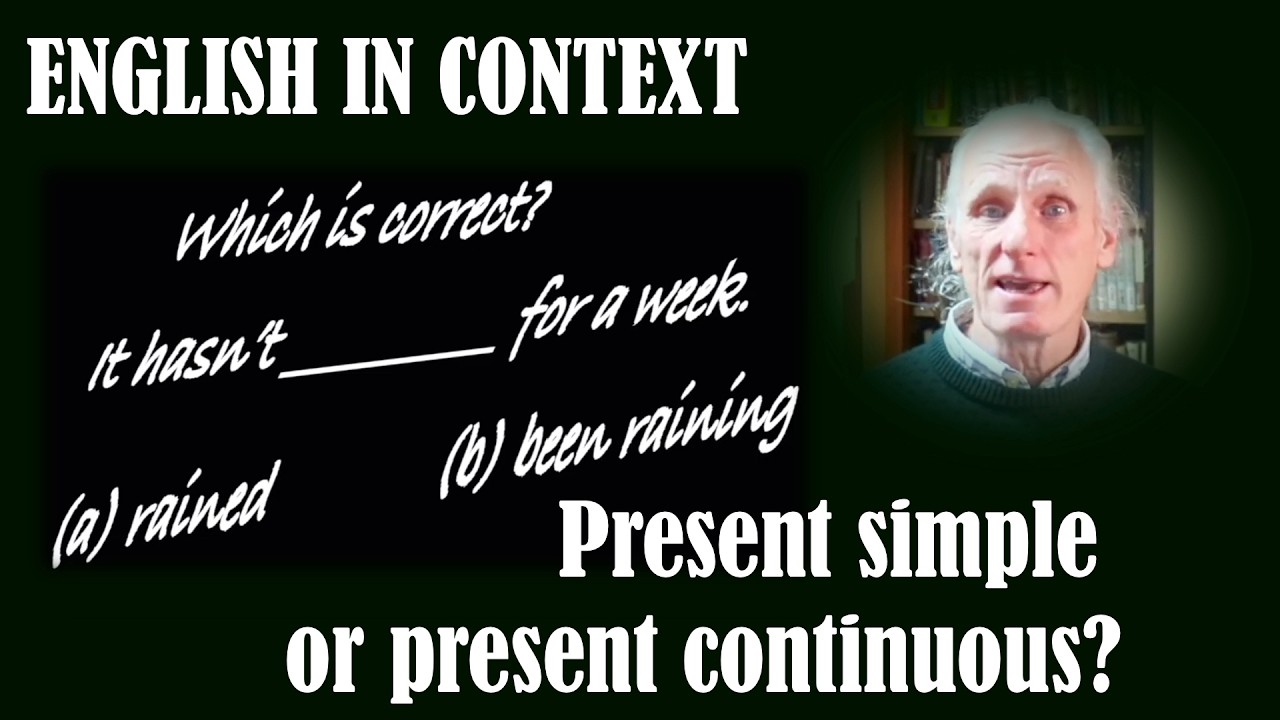
🧑🎓ENGLISH IN CONTEXT. It hasn't rained / been raining for a week. Are they both correct? Why? 👀
Grammatical constructions without context are of very little use. This ...
Grammatical constructions without context are of very little use. This video is part of a series of short videos explaining in detail the situations in which certain expressions are used. ...The course is aimed at teachers of English and upper-intermediate or advanced students.
In this video, I look at two constructions, "It hasn't rained for a week" (present perfect simple) and "It hasn't been raining for a week" (present perfect continuous). The first construction is more usual, but the second is also grammatically correct. Is there a context in which it could be used? Watch this video and find out!
A version of this video was published previously on the SPEECC (Sophia Practical English Education and Communication Circle) channel (https://www.youtube.com/channel/UCpTcHPqURrUTuPpPJktipgg)
If you would like subtitles in a language not listed, please let me know and I will add them if possible.
© All rights reserved
Translated titles:
АНГЛИЙСКИЙ В КОНТЕКСТЕ: It hasn't rained / been raining for a week
INGLÉS EN CONTEXTO: It hasn't rained / been raining for a week
DEUTSCH IM KONTEXT: It hasn't rained / been raining for a week
L'ANGLAIS EN CONTEXTE: It hasn't rained / been raining for a week
INGLÊS NO CONTEXTO: It hasn't rained / been raining for a week
संपर्क में अंग्रेजी: It hasn't rained / been raining for a week
اللغة الإنجليزية في السياق: It hasn't rained / been raining for a week
上下文中的英语:It hasn't rained / been raining for a week
上下文中的英語:It hasn't rained / been raining for a week
INGLESE NEL CONTESTO: It hasn't rained / been raining for a week
文脈における英語:It hasn't rained / been raining for a week
Subtítulos 字幕 Imibhalo engezansi 字幕 phụ đề سب ٹائٹلز Altyazılar คำบรรยาย ఉపశీర్షికలు வசன வரிகள் Субтитры Legendas Napisy na filmie obcojęzycznym ਉਪਸਿਰਲੇਖ उपशीर्षके Sari kata 자막 ಉಪಶೀರ್ಷಿಕೆಗಳು Sottotitoli Mga Subtitle Subtitles उपशीर्षक સબટાઈટલ Sous-titres زیرنویس Υπότιτλοι Untertitel সাবটাইটেল ترجمات التسميات التوضيحية ক্যাপশন Bildunterschriften λεζάντες زیرنویس ها Mga Caption captions legends કૅપ્શન્સ
कैप्शन keterangan didascalie ಶೀರ್ಷಿಕೆಗಳು 캡션 kapsyen मथळे ਸੁਰਖੀਆਂ napisy подписи தலைப்புகள் శీర్షికలు คำบรรยายภาพ کیپشنز chú thích amazwibela キャプション manukuu maelezo mafupi ఉపశీర్షికలు శీర్షికలు titulkyShow More
In this video, I look at two constructions, "It hasn't rained for a week" (present perfect simple) and "It hasn't been raining for a week" (present perfect continuous). The first construction is more usual, but the second is also grammatically correct. Is there a context in which it could be used? Watch this video and find out!
A version of this video was published previously on the SPEECC (Sophia Practical English Education and Communication Circle) channel (https://www.youtube.com/channel/UCpTcHPqURrUTuPpPJktipgg)
If you would like subtitles in a language not listed, please let me know and I will add them if possible.
© All rights reserved
Translated titles:
АНГЛИЙСКИЙ В КОНТЕКСТЕ: It hasn't rained / been raining for a week
INGLÉS EN CONTEXTO: It hasn't rained / been raining for a week
DEUTSCH IM KONTEXT: It hasn't rained / been raining for a week
L'ANGLAIS EN CONTEXTE: It hasn't rained / been raining for a week
INGLÊS NO CONTEXTO: It hasn't rained / been raining for a week
संपर्क में अंग्रेजी: It hasn't rained / been raining for a week
اللغة الإنجليزية في السياق: It hasn't rained / been raining for a week
上下文中的英语:It hasn't rained / been raining for a week
上下文中的英語:It hasn't rained / been raining for a week
INGLESE NEL CONTESTO: It hasn't rained / been raining for a week
文脈における英語:It hasn't rained / been raining for a week
Subtítulos 字幕 Imibhalo engezansi 字幕 phụ đề سب ٹائٹلز Altyazılar คำบรรยาย ఉపశీర్షికలు வசன வரிகள் Субтитры Legendas Napisy na filmie obcojęzycznym ਉਪਸਿਰਲੇਖ उपशीर्षके Sari kata 자막 ಉಪಶೀರ್ಷಿಕೆಗಳು Sottotitoli Mga Subtitle Subtitles उपशीर्षक સબટાઈટલ Sous-titres زیرنویس Υπότιτλοι Untertitel সাবটাইটেল ترجمات التسميات التوضيحية ক্যাপশন Bildunterschriften λεζάντες زیرنویس ها Mga Caption captions legends કૅપ્શન્સ
कैप्शन keterangan didascalie ಶೀರ್ಷಿಕೆಗಳು 캡션 kapsyen मथळे ਸੁਰਖੀਆਂ napisy подписи தலைப்புகள் శీర్షికలు คำบรรยายภาพ کیپشنز chú thích amazwibela キャプション manukuu maelezo mafupi ఉపశీర్షికలు శీర్షికలు titulkyShow More

Now Playing
🧑🎓SPOTLIGHT ON ENGLISH Present perfect continuous/present perfect simple I HAVE LIVED/BEEN LIVING👀
If you just want the easy answer, don't come to me! Only come to me if ...

If you just want the easy answer, don't come to me! Only come to me if you want the right answer! Did you know that teachers and textbooks often get ...this wrong? This video will clear up any confusion and give you a clear explanation of how we use the present perfect simple and present perfect continuous forms of the verb.
Support Ano sensei: Do you want "Ano sensei!" to keep on making videos like this? And get sneak previews, premium content and priority replies to your questions and comments into the bargain? Take out a channel membership (click "Join") or join me on Patreon (https://www.patreon.com/ano_sensei)!
0:00 Introduction
0:10 The basic difference between present perfect simple and continuous
1:30 Stative verbs ("know", "like", "seem", etc.)
2:53 Verbs like "live", "work" and "study"
3:29 The mistake a lot of textbooks make
4:19 Native speaker usage as seen in a Google search
6:04 A better explanation
6:54 "Live" as an activity
7:47 "Live" as an action
8:34 Find out more
8:58 That's all!
Textbook and online explanations of the difference between, for example, "I have lived in Paris" and "I have been living in Paris" are very often incomplete or just plain wrong! This video leads you through the basic uses of the present perfect simple and continuous with action verbs and stative verbs and then goes on to look at verbs like "live", "work" and "study" in detail.
Follow the "Spotlight on English" playlist here: https://www.youtube.com/watch?v=ZZvHkDYbNh8&list=PLzVb6yL_jY6-h9u2k0W6ylDih3m0bbPAo
Perfect aspect playlist: https://www.youtube.com/watch?v=5qOixhRm_J4&list=PLzVb6yL_jY6_x_BlR_i4UjiW6DB1XRPM_
The "Ano sensei!" website: https://educationalhub.org/anosensei/
If your language is not listed in the subtitles, please let me know and I will add it.
© All rights reserved
Translated titles:
ENFOQUE EN INGLÉS: Presente perfecto: HE VIVIDO / ESTADO VIVIENDO. ¡La explicación correcta!
SPOTLIGHT ON ENGLISH: Perfekt präsentieren: Ich habe gelebt / gelebt. Die richtige Erklärung!
PLEINS FEUX SUR L'ANGLAIS: Présent parfait: J'AI VÉCU / ÉTÉ VIVANT. La bonne explication!
EM INGLÊS: Presente perfeito: EU VIVI / ESTOU VIVENDO. A explicação correta!
تسليط الضوء على اللغة الإنجليزية: المضارع التام: لقد عش
聚焦英语:完美的礼物:我过着生活/过着生活。正确的解释!
聚焦英語:完美的禮物:我過著生活/過著生活。正確的解釋!
RIFLETTORI SULL'INGLESE: Presente perfetto: HO VISSUTO / STATO VIVENDO. La spiegazione corretta!
英語のスポットライト:現在完了形:私は生きている/生きている。正しい
ПРОЦЕСС НА АНГЛИЙСКОМ ЯЗЫКЕ: Настоящее время идеально
Subtítulos 字幕 Imibhalo engezansi 字幕 phụ đề سب ٹائٹلز Altyazılar คำบรรยาย ఉపశీర్షికలు வசன வரிகள் Субтитры Legendas Napisy na filmie obcojęzycznym ਉਪਸਿਰਲੇਖ उपशीर्षके Sari kata 자막 ಉಪಶೀರ್ಷಿಕೆಗಳು Sottotitoli Mga Subtitle Subtitles उपशीर्षक સબટાઈટલ Sous-titres زیرنویس Υπότιτλοι Untertitel সাবটাইটেল ترجمات التسميات التوضيحية ক্যাপশন Bildunterschriften λεζάντες زیرنویس ها Mga Caption captions legends કૅપ્શન્સ
कैप्शन keterangan didascalie ಶೀರ್ಷಿಕೆಗಳು 캡션 kapsyen मथळे ਸੁਰਖੀਆਂ napisy подписи தலைப்புகள் శీర్షికలు คำบรรยายภาพ کیپشنز chú thích amazwibela キャプション manukuu maelezo mafupi ఉపశీర్షికలు శీర్షికలు titulkyShow More
Support Ano sensei: Do you want "Ano sensei!" to keep on making videos like this? And get sneak previews, premium content and priority replies to your questions and comments into the bargain? Take out a channel membership (click "Join") or join me on Patreon (https://www.patreon.com/ano_sensei)!
0:00 Introduction
0:10 The basic difference between present perfect simple and continuous
1:30 Stative verbs ("know", "like", "seem", etc.)
2:53 Verbs like "live", "work" and "study"
3:29 The mistake a lot of textbooks make
4:19 Native speaker usage as seen in a Google search
6:04 A better explanation
6:54 "Live" as an activity
7:47 "Live" as an action
8:34 Find out more
8:58 That's all!
Textbook and online explanations of the difference between, for example, "I have lived in Paris" and "I have been living in Paris" are very often incomplete or just plain wrong! This video leads you through the basic uses of the present perfect simple and continuous with action verbs and stative verbs and then goes on to look at verbs like "live", "work" and "study" in detail.
Follow the "Spotlight on English" playlist here: https://www.youtube.com/watch?v=ZZvHkDYbNh8&list=PLzVb6yL_jY6-h9u2k0W6ylDih3m0bbPAo
Perfect aspect playlist: https://www.youtube.com/watch?v=5qOixhRm_J4&list=PLzVb6yL_jY6_x_BlR_i4UjiW6DB1XRPM_
The "Ano sensei!" website: https://educationalhub.org/anosensei/
If your language is not listed in the subtitles, please let me know and I will add it.
© All rights reserved
Translated titles:
ENFOQUE EN INGLÉS: Presente perfecto: HE VIVIDO / ESTADO VIVIENDO. ¡La explicación correcta!
SPOTLIGHT ON ENGLISH: Perfekt präsentieren: Ich habe gelebt / gelebt. Die richtige Erklärung!
PLEINS FEUX SUR L'ANGLAIS: Présent parfait: J'AI VÉCU / ÉTÉ VIVANT. La bonne explication!
EM INGLÊS: Presente perfeito: EU VIVI / ESTOU VIVENDO. A explicação correta!
تسليط الضوء على اللغة الإنجليزية: المضارع التام: لقد عش
聚焦英语:完美的礼物:我过着生活/过着生活。正确的解释!
聚焦英語:完美的禮物:我過著生活/過著生活。正確的解釋!
RIFLETTORI SULL'INGLESE: Presente perfetto: HO VISSUTO / STATO VIVENDO. La spiegazione corretta!
英語のスポットライト:現在完了形:私は生きている/生きている。正しい
ПРОЦЕСС НА АНГЛИЙСКОМ ЯЗЫКЕ: Настоящее время идеально
Subtítulos 字幕 Imibhalo engezansi 字幕 phụ đề سب ٹائٹلز Altyazılar คำบรรยาย ఉపశీర్షికలు வசன வரிகள் Субтитры Legendas Napisy na filmie obcojęzycznym ਉਪਸਿਰਲੇਖ उपशीर्षके Sari kata 자막 ಉಪಶೀರ್ಷಿಕೆಗಳು Sottotitoli Mga Subtitle Subtitles उपशीर्षक સબટાઈટલ Sous-titres زیرنویس Υπότιτλοι Untertitel সাবটাইটেল ترجمات التسميات التوضيحية ক্যাপশন Bildunterschriften λεζάντες زیرنویس ها Mga Caption captions legends કૅપ્શન્સ
कैप्शन keterangan didascalie ಶೀರ್ಷಿಕೆಗಳು 캡션 kapsyen मथळे ਸੁਰਖੀਆਂ napisy подписи தலைப்புகள் శీర్షికలు คำบรรยายภาพ کیپشنز chú thích amazwibela キャプション manukuu maelezo mafupi ఉపశీర్షికలు శీర్షికలు titulkyShow More

Now Playing
🧑🎓BASIC ENGLISH GRAMMAR: ENGLISH IN CONTEXT. "Gone to" / "been to". Many textbooks get this wrong!👀
Textbooks and teachers often give misleading information about "gone ...
Textbooks and teachers often give misleading information about "gone to" and "been to". In particular, students are often taught that if someone has "been to" a place they have gone ...and come back. This may often be the case but - as this video explains - but it isn't always so.
This "English in context" series is designed for teachers and more advanced students who are looking for detailed and comprehensive explanations of aspects of English that are frequently overlooked or misrepresented in the language classroom.
This is an "Ano sensei!" production (https://www.youtube.com/anosensei).
A version of this video was published previously on the SPEECC (Sophia Practical English Education and Communication Circle) channel (https://www.youtube.com/channel/UCpTcHPqURrUTuPpPJktipgg).
If subtitles are not available in your language, please let me know and I will add them.
© All rights reserved
Translated titles:
INGLÉS EN CONTEXTO: "gone to" vs. "been to ". ¡Es posible que la diferencia no sea lo que usted cr
DEUTSCH IM KONTEXT: "gone to" vs. "been to ". Der Unterschied ist möglicherweise nicht das, was Sie
L'ANGLAIS EN CONTEXTE: "gone to" vs "been to ". La différence n'est peut-être pas ce que vous pens
INGLÊS NO CONTEXTO: "gone to" vs. "been to ". A diferença pode não ser o que você pensa!
اللغة الإنجليزية في السياق: "gone to" مقابل "been to ". قد لا يكو
在上下文中使用英语:"gone to"vs."been to“。区别可能与您想像的不一样!
INGLESE NEL CONTESTO: "gone to" vs. "been to ". La differenza potrebbe non essere quella che pensi!
英語の文脈:"gone to"対"been to "。違いはあなたが思っているものではないか
АНГЛИЙСКИЙ В КОНТЕКСТЕ: "gone to" vs. "been to ". Разница может бы
BAĞLAMDA İNGİLİZCE: "gone to"-"been to ". Fark, düşündüğünüz şey olmayabilir!
Subtítulos 字幕 Imibhalo engezansi 字幕 phụ đề سب ٹائٹلز Altyazılar คำบรรยาย ఉపశీర్షికలు வசன வரிகள் Субтитры Legendas Napisy na filmie obcojęzycznym ਉਪਸਿਰਲੇਖ उपशीर्षके Sari kata 자막 ಉಪಶೀರ್ಷಿಕೆಗಳು Sottotitoli Mga Subtitle Subtitles उपशीर्षक સબટાઈટલ Sous-titres زیرنویس Υπότιτλοι Untertitel সাবটাইটেল ترجمات التسميات التوضيحية ক্যাপশন Bildunterschriften λεζάντες زیرنویس ها Mga Caption captions legends કૅપ્શન્સ
कैप्शन keterangan didascalie ಶೀರ್ಷಿಕೆಗಳು 캡션 kapsyen मथळे ਸੁਰਖੀਆਂ napisy подписи தலைப்புகள் శీర్షికలు คำบรรยายภาพ کیپشنز chú thích amazwibela キャプション manukuu maelezo mafupi ఉపశీర్షికలు శీర్షికలు titulkyShow More
This "English in context" series is designed for teachers and more advanced students who are looking for detailed and comprehensive explanations of aspects of English that are frequently overlooked or misrepresented in the language classroom.
This is an "Ano sensei!" production (https://www.youtube.com/anosensei).
A version of this video was published previously on the SPEECC (Sophia Practical English Education and Communication Circle) channel (https://www.youtube.com/channel/UCpTcHPqURrUTuPpPJktipgg).
If subtitles are not available in your language, please let me know and I will add them.
© All rights reserved
Translated titles:
INGLÉS EN CONTEXTO: "gone to" vs. "been to ". ¡Es posible que la diferencia no sea lo que usted cr
DEUTSCH IM KONTEXT: "gone to" vs. "been to ". Der Unterschied ist möglicherweise nicht das, was Sie
L'ANGLAIS EN CONTEXTE: "gone to" vs "been to ". La différence n'est peut-être pas ce que vous pens
INGLÊS NO CONTEXTO: "gone to" vs. "been to ". A diferença pode não ser o que você pensa!
اللغة الإنجليزية في السياق: "gone to" مقابل "been to ". قد لا يكو
在上下文中使用英语:"gone to"vs."been to“。区别可能与您想像的不一样!
INGLESE NEL CONTESTO: "gone to" vs. "been to ". La differenza potrebbe non essere quella che pensi!
英語の文脈:"gone to"対"been to "。違いはあなたが思っているものではないか
АНГЛИЙСКИЙ В КОНТЕКСТЕ: "gone to" vs. "been to ". Разница может бы
BAĞLAMDA İNGİLİZCE: "gone to"-"been to ". Fark, düşündüğünüz şey olmayabilir!
Subtítulos 字幕 Imibhalo engezansi 字幕 phụ đề سب ٹائٹلز Altyazılar คำบรรยาย ఉపశీర్షికలు வசன வரிகள் Субтитры Legendas Napisy na filmie obcojęzycznym ਉਪਸਿਰਲੇਖ उपशीर्षके Sari kata 자막 ಉಪಶೀರ್ಷಿಕೆಗಳು Sottotitoli Mga Subtitle Subtitles उपशीर्षक સબટાઈટલ Sous-titres زیرنویس Υπότιτλοι Untertitel সাবটাইটেল ترجمات التسميات التوضيحية ক্যাপশন Bildunterschriften λεζάντες زیرنویس ها Mga Caption captions legends કૅપ્શન્સ
कैप्शन keterangan didascalie ಶೀರ್ಷಿಕೆಗಳು 캡션 kapsyen मथळे ਸੁਰਖੀਆਂ napisy подписи தலைப்புகள் శీర్షికలు คำบรรยายภาพ کیپشنز chú thích amazwibela キャプション manukuu maelezo mafupi ఉపశీర్షికలు శీర్షికలు titulkyShow More

Now Playing
🧑🎓BASIC ENGLISH GRAMMAR: ENGLISH IN CONTEXT. "Have studied" and "have been studying"👀
If you just want the easy answer, don't come to me! Only come to me if ...
If you just want the easy answer, don't come to me! Only come to me if you want the right answer! For further information on this topic, check the following ...link: https://youtu.be/ZZvHkDYbNh8?t=209
The use of the present perfect simple and present perfect continuous is fairly straightforward, except for a small group of verbs (such as "live", "work" and "study") that can be used both as stative verbs and as action verbs with very little difference in meaning.
The usage of present perfect simple and continuous with this group of verbs is frequently mistaught. This video explains that, in most contexts, the two forms are interchangeable. If you want to know about the occasions when they are not interchangeable, please click on this link: https://youtu.be/ZZvHkDYbNh8?t=209
A version of this video was published previously on the SPEECC (Sophia Practical English Education and Communication Circle) channel (https://www.youtube.com/channel/UCpTcHPqURrUTuPpPJktipgg).
This is an "Ano sensei!" production (https://www.youtube.com/anosensei).
© All rights reserved
Translated titles:
BAĞLAMDA İNGİLİZCE: "Have studied" ve "have been studying"
语境英语:"Have studied" 和 "have been studying"
INGLESE IN CONTESTO: "Have studied" e "have been studying"
文脈における英語:"Have studied"および"have been studying"
맥락에서의 영어 : "Have studied" 및 "have been studying"
АНГЛИЙСКИЙ В КОНТЕКСТЕ: "Have studied" и "have been studying"
INGLÉS EN CONTEXTO: "Have studied" y "have been studying"
ENGLISCH IM KONTEXT: "Have studied" und "have been studying"
ANGLAIS EN CONTEXTE : "Have studied" et "have been studying"
اللغة الإنجليزية في السياق: "Have studied" و "have been studying"
Subtítulos 字幕 Imibhalo engezansi 字幕 phụ đề سب ٹائٹلز Altyazılar คำบรรยาย ఉపశీర్షికలు வசன வரிகள் Субтитры Legendas Napisy na filmie obcojęzycznym ਉਪਸਿਰਲੇਖ उपशीर्षके Sari kata 자막 ಉಪಶೀರ್ಷಿಕೆಗಳು Sottotitoli Mga Subtitle Subtitles उपशीर्षक સબટાઈટલ Sous-titres زیرنویس Υπότιτλοι Untertitel সাবটাইটেল ترجمات التسميات التوضيحية ক্যাপশন Bildunterschriften λεζάντες زیرنویس ها Mga Caption captions legends કૅપ્શન્સ
कैप्शन keterangan didascalie ಶೀರ್ಷಿಕೆಗಳು 캡션 kapsyen मथळे ਸੁਰਖੀਆਂ napisy подписи தலைப்புகள் శీర్షికలు คำบรรยายภาพ کیپشنز chú thích amazwibela キャプション manukuu maelezo mafupi ఉపశీర్షికలు శీర్షికలు titulkyShow More
The use of the present perfect simple and present perfect continuous is fairly straightforward, except for a small group of verbs (such as "live", "work" and "study") that can be used both as stative verbs and as action verbs with very little difference in meaning.
The usage of present perfect simple and continuous with this group of verbs is frequently mistaught. This video explains that, in most contexts, the two forms are interchangeable. If you want to know about the occasions when they are not interchangeable, please click on this link: https://youtu.be/ZZvHkDYbNh8?t=209
A version of this video was published previously on the SPEECC (Sophia Practical English Education and Communication Circle) channel (https://www.youtube.com/channel/UCpTcHPqURrUTuPpPJktipgg).
This is an "Ano sensei!" production (https://www.youtube.com/anosensei).
© All rights reserved
Translated titles:
BAĞLAMDA İNGİLİZCE: "Have studied" ve "have been studying"
语境英语:"Have studied" 和 "have been studying"
INGLESE IN CONTESTO: "Have studied" e "have been studying"
文脈における英語:"Have studied"および"have been studying"
맥락에서의 영어 : "Have studied" 및 "have been studying"
АНГЛИЙСКИЙ В КОНТЕКСТЕ: "Have studied" и "have been studying"
INGLÉS EN CONTEXTO: "Have studied" y "have been studying"
ENGLISCH IM KONTEXT: "Have studied" und "have been studying"
ANGLAIS EN CONTEXTE : "Have studied" et "have been studying"
اللغة الإنجليزية في السياق: "Have studied" و "have been studying"
Subtítulos 字幕 Imibhalo engezansi 字幕 phụ đề سب ٹائٹلز Altyazılar คำบรรยาย ఉపశీర్షికలు வசன வரிகள் Субтитры Legendas Napisy na filmie obcojęzycznym ਉਪਸਿਰਲੇਖ उपशीर्षके Sari kata 자막 ಉಪಶೀರ್ಷಿಕೆಗಳು Sottotitoli Mga Subtitle Subtitles उपशीर्षक સબટાઈટલ Sous-titres زیرنویس Υπότιτλοι Untertitel সাবটাইটেল ترجمات التسميات التوضيحية ক্যাপশন Bildunterschriften λεζάντες زیرنویس ها Mga Caption captions legends કૅપ્શન્સ
कैप्शन keterangan didascalie ಶೀರ್ಷಿಕೆಗಳು 캡션 kapsyen मथळे ਸੁਰਖੀਆਂ napisy подписи தலைப்புகள் శీర్షికలు คำบรรยายภาพ کیپشنز chú thích amazwibela キャプション manukuu maelezo mafupi ఉపశీర్షికలు శీర్షికలు titulkyShow More

Now Playing
🧑🎓 Why do we need past perfect? Why not just use the past simple? Ano sensei explains. 👀
The past perfect is often described as being the tense we use when one ...
The past perfect is often described as being the tense we use when one thing happens before something else in the past. But there's more to it than that. Ano ...sensei explains...
© All rights reservedShow More
