
Author: Ano Sensei
Format: Video
Structure: Iambic pentameter, Ode stanza
Related content:
- • Keats: Ode to a Nightingale – Experimental Setting to Music (Techno Trance) (Video)
- • Keats: Ode on a Grecian Urn – Reading & Analysis (Playlist) (Video Playlist)
- • Keats: To Autumn – Reading & Analysis (Playlist) (Video Playlist)
- • Keats: Ode to a Nightingale – Reading & Analysis (Playlist) (Video Playlist)
- • Keats: Odes – Reading & Analysis (Playlist) (Video Playlist)
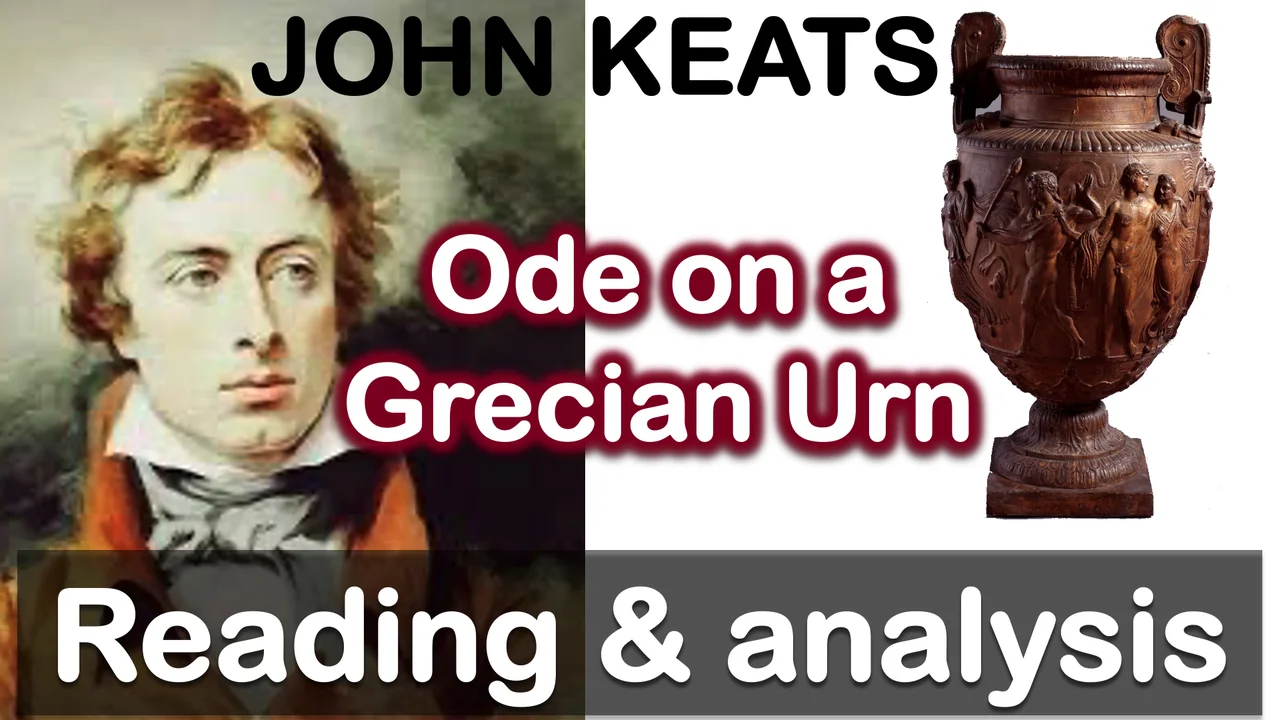
John Keats "Ode on a Grecian Urn". Reading and Analysis. Interactive Q&A for classroom/personal use
This video offers a complete reading ...and stanza-by-stanza analysis of "Ode on a Grecian Urn." Starting with the urn itself — a silent, unchanging world of frozen figures — it traces Keats's exploration of imagination versus reality, happiness and suffering, and the world of art as both an escape from and a reflection of human pain.
Along the way: Why are the unheard melodies sweeter than those we can actually hear? Why does "happy happy love" leave the heart "high sorrowful"? What is the mysterious little town, and why is it forever desolate? And what should we make of those famously controversial final lines?
Most poetry analysis videos talk at you. This one talks with you. At key moments throughout the analysis — when Keats poses a question, introduces a new image, or builds toward a difficult conclusion — the video pauses with a five-second countdown, inviting you to think before the analysis continues. You can pause, discuss, or simply reflect.
This makes the video genuinely useful for classroom discussion — teachers can pause and open the question to the room — as well as for individual learners who want to engage actively with the poem rather than simply absorb someone else's interpretation.
Ano Sensei (AKA John R. Yamamoto-Wilson) holds a PhD from the University of Cambridge and taught English literature at Sophia University, Tokyo, for many years.
0:00 Introduction
0:06 Reading — Stanza I
0:46 Analysis — Stanza I: The urn as Sylvan historian
4:43 Reading — Stanza II
5:32 Analysis — Stanza II: Heard and unheard melodies
8:53 Reading — Stanza III
9:35 Analysis — Stanza III: "Happy, happy love"
12:12 Reading — Stanza IV
12:50 Analysis — Stanza IV: The mysterious priest and the little town
16:12 Reading — Stanza V
16:52 Analysis — Stanza V: "Beauty is truth, truth beauty"
This video can also be watched as a playlist (https://www.youtube.com/playlist?list=PLzVb6yL_jY69RMez733LUEYNI4-LgSjGh), or as separate reading (https://youtu.be/sbmiq_70dpg) and analysis (https://youtu.be/QOmQNP26Lak).
© All rights reservedShow More