
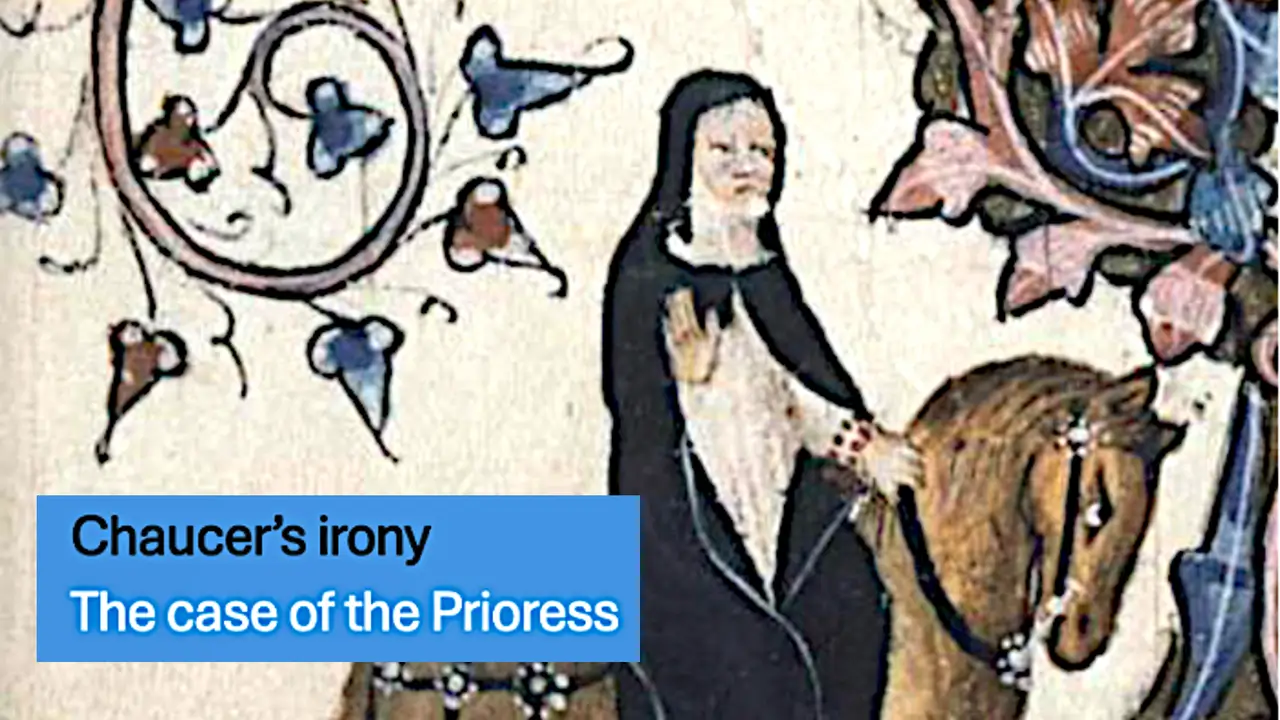
Geoffrey Chaucer’s portrait of the Prioress in the Canterbury Tales is one of the most brilliantly sustained examples of irony in English literature. To a medieval reader, Madame Eglentyne was unmistakably comic: a nun who violates her vows of poverty, chastity and obedience at almost every turn, feeds her dogs roasted meat while the poor go hungry, and wears a gold brooch engraved with a courtly love motto. The satire would have been obvious to Chaucer’s contemporaries — and yet, from the 18th century to the early 20th century, most readers took Chaucer’s description of the Prioress at face value, missing the irony altogether.
Here I tell the story of how that happened, and how modern criticism eventually found its way back to Chaucer’s original intent.
The loss of Chaucer’s irony was not a simple failure of intelligence. It was the cumulative result of three distinct historical processes: the cultural amnesia brought about by the Reformation and the dissolution of the monasteries, which erased a thousand years of living knowledge about monastic life; the emergence of Romantic medievalism in the eighteenth century, which constructed an imaginary Middle Ages of simplicity, naivety and authentic feeling; and the religious culture of Victorian England, in which the Prioress’s hypocritical behaviour looked indistinguishable from sincere piety — because Victorian religion demanded exactly the same outward performance that medieval hypocrisy produced.
Alexander Pope’s 1741 modernisation of the Canterbury Tales was a pivotal moment: presenting the Prioress unironically as a paragon of Christian virtue, Pope set the terms for two centuries of misreading. It was not until E. Talbot Donaldson’s landmark 1954 essay “Chaucer the Pilgrim” that recognition of the irony became mainstream — and even then, it built on the largely overlooked historical scholarship of Eileen Power, who, approaching it as a historian with a clear grasp on the realities of medieval monasticism, had identified the satirical pattern thirty years earlier.
The case of the Prioress raises a question that reaches beyond Chaucer: if Victorian scholars could miss something so fundamental, what might we be missing that will cause future generations to look back on us with amused surprise?
Misreading Chaucer across the centuries
Geoffrey Chaucer’s portrait of the Prioress in the Canterbury Tales is one of the most brilliantly sustained examples of irony in English literature. To a medieval reader, Madame Eglentyne was unmistakably comic: a nun who violates her vows of poverty, chastity and obedience at almost every turn, feeds her dogs roasted meat while the poor go hungry, and wears a gold brooch engraved with a courtly love motto. The satire would have been obvious to Chaucer’s contemporaries — and yet, from the 18th century to the early 20th century, most readers took Chaucer’s description of the Prioress at face value, missing the irony altogether.
Here I tell the story of how that happened, and how modern criticism eventually found its way back to Chaucer’s original intent.
The loss of Chaucer’s irony was not a simple failure of intelligence. It was the cumulative result of three distinct historical processes: the cultural amnesia brought about by the Reformation and the dissolution of the monasteries, which erased a thousand years of living knowledge about monastic life; the emergence of Romantic medievalism in the eighteenth century, which constructed an imaginary Middle Ages of simplicity, naivety and authentic feeling; and the religious culture of Victorian England, in which the Prioress’s hypocritical behaviour looked indistinguishable from sincere piety — because Victorian religion demanded exactly the same outward performance that medieval hypocrisy produced.
Alexander Pope’s 1741 modernisation of the Canterbury Tales was a pivotal moment: presenting the Prioress unironically as a paragon of Christian virtue, Pope set the terms for two centuries of misreading. It was not until E. Talbot Donaldson’s landmark 1954 essay “Chaucer the Pilgrim” that recognition of the irony became mainstream — and even then, it built on the largely overlooked historical scholarship of Eileen Power, who, approaching it as a historian with a clear grasp on the realities of medieval monasticism, had identified the satirical pattern thirty years earlier.
The case of the Prioress raises a question that reaches beyond Chaucer: if Victorian scholars could miss something so fundamental, what might we be missing that will cause future generations to look back on us with amused surprise?