
Author: Ano Sensei
Format: Video
Structure: Drama, Iambic pentameter
Related content:
- • Who Were Shakespeare’s Friends? The Stratford Circle (Video)
- • Shakespeare’s Stratford Friends: A Study Guide (Digital Booklet)
- • Shakespeare, Hamlet: “To Be or Not to Be” – Revenge, Suicide, and the Ethics of Action (Study Guide)
- • Shakespeare’s Stratford Friends: His Social Circle in His Home Town (Video Playlist)
- • Shakespeare’s Metre: How Rigid is His Iambic Pentameter? (Video)
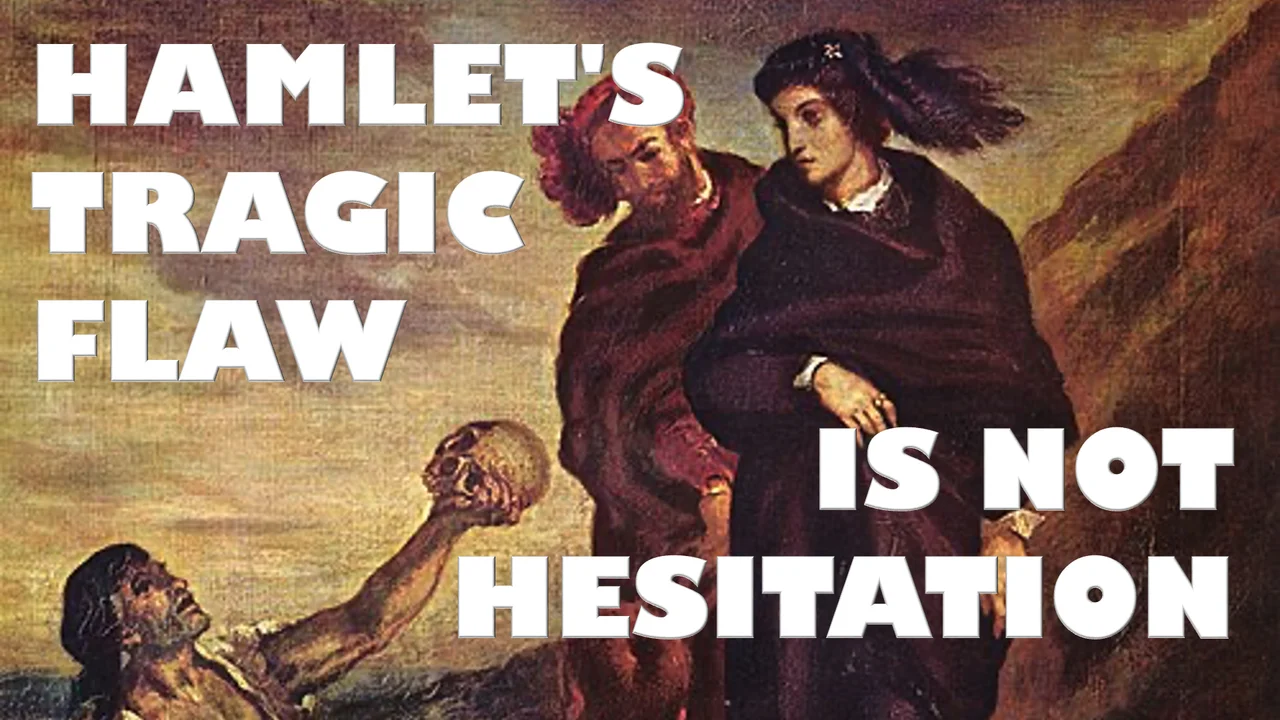
"To be or not to be": Hamlet's tragic flaw is NOT hesitation - and it matters!
0:00 Introduction
0:27 Hamlet's hesitation
1:36 Suicide
2:32 Revenge and the Bible
4:21 "To be or not to be" analysis
4:31 Lines 1-5
5:50 Lines 5-9
6:22 Lines 9-13
7:04 Lines 13-27
9:29 Lines 28-32
10:58 Hamlet's real tragic flaw
12:40 Why it matters
14:45 Life's more fun with Ano sensei!
As always, if you want subtitles in a language that is not listed, just let me know and I will add them.
© All rights reservedShow More
68 Comments
Disagree. He had no choice. Hamlet had to kill Claudius. And die himself. It’s a tragedy. Sometimes there is no choice. That’s called tragedy. And it’s silly to compare his obligation to open carry of weapons now. Claudius had to be killed. And Mr. Ghost makes it clear who has to do it. Father/son. Yahweh/Jesus. An old story, no?
As I say in the video, you don’t have to agree with me. I’m not even 100% sure I agree with myself her, though I still feel that that the ethics of revenge form part of what this speech is about. And I don’t think the comparison between Elizabethans carrying swords and open carry in the US is silly. But there are some aspects of the argument that I’d probably handle rather differently if I were making the video today. I won’t go into it in depth with you; if you take a look at some of the comment threads here, you’ll see I’ve already discussed this from pretty much every angle with others.
@anosenseiI just wrote 3 pages about a conversation I had with Hamlet, who dragooned me into conversation. Do you have an email where I can send it. It would be helpful to get your opinion whether you find it funny (or dreary)
My thesis is that Hamlet only has 3 hours to figure out what to do. So considering the pressure of time, he goes pretty fast.
@Jalcolm1 You could message me on Facebook: https://www.facebook.com/anosensei/
Ahh. Finally someone who understands what the play is really about. Worth listening to. Terrific job.
Thanks for the thumbs-up! I’ve had quite a bit of pushback on this one, as well as a lot of support, and if I were making the video now I might change it a bit. I still think it’s about revenge, but, taking into account other factors, it could well be that there is some level of ambiguity running through the speech and it functions on more than one level.
IOW, he was wrong about what the question was. Not to be or not to be but how or what to be. But those choices weren’t even available or cognizable either in Hamlet’s time or Shakespeare’s. And maybe that’s the true tragedy.
If I understand you right, you’re looking at the speech as a kind of existentialism _avant la lettre_. I agree, it does seem to come close.
I would make the video a little differently if I were making it today, but I would still base it on the assumption that the speech is internally consistent, and that the conclusion – that “the native hue of Resolution / Is sicklied o’er, with the pale cast of Thought, / And enterprises of great pitch and moment, / With this regard their Currents turn awry / And lose the name of Action” – completes the thought begun in the opening line. If that is so, then, yes, as you say, the central theme is how we define ourselves through our actions.
My only quibble would be on the matter of what was conceptually cognizable. Clearly, the question of whether we have choices was available in Shakespeare’s day, and indeed underpins the whole free will / predestination dichotomy that was such a central concern in Elizabethan times.
“To do is to be” (echoing Socrates) and “To be is to do”, echoing Sartre, may be 1960s grafitti twists on philosophy, but the idea that we do have choices is perhaps the foundation rock on which Western philosophy is built.
Nope. Just because ‘be’ and ‘oppose’ are active and by natural contrast ‘suffer’ and ‘not to be’ are passive, why is suffering the slings and arrows equivalent to nonexistence? Yes ‘quietus’ is quittance but there’s no mistaking the consonance between ‘quiet’ and ‘sleep’, and since ‘sleep’ in this context means death, making one’s own quietus means suicide. And a bodkin is a pin: see Seneca’s Letter 70: one can do oneself in with a ‘scalpello’ and ‘puncto’. ‘To be or not to be’ is NOTHING to do with the ethics of revenge, but let’s say it were: what is it doing in the middle of the nunnery scene?
There’s a lot to disagree with there. You make an egregious error when you claim that “a bodkin is a pin”. Seneca wrote in Latin centuries before English even existed, so he certainly never used the word “bodkin” and we can rule out anything in his letters as irrelevant. The modern usage of the word is also irrelevant, since words change their meaning over time. The only things we need to concern ourselves with here are the semantic origins of the word and its meaning in Elizabethan times, which you can learn about here: https://www.etymonline.com/word/bodkin (spoiler: a bodkin is a short dagger).
A lot hangs on that word “quietus”. I have combed the entire EEBO database (https://quod.lib.umich.edu/e/eebogroup/), looking at every single usage of the word “quietus” and, apart from its supposed meaning in Hamlet’s speech, there is not one in which it means “suicide”. It always means “settle one’s debts”, either literally or figuratively (i.e., by taking revenge). All we have is the circular logic of “‘making one’s quietus’ in Hamlet’s speech means ‘committing suicide’, because that is how Hamlet uses it in his speech”.
You ask “why is suffering the slings and arrows equivalent to nonexistence?” This indicates that you have missed the central point of my argument. By this stage in the play, the big issue is not whether Hamlet is going to kill himself or not. That has already been mooted and discarded as a possibility. The big issue is whether the revenge itself is going to take place or not – whether “the native hue of resolution” will manifest itself, or whether this enterprise “of great pith and moment” will “lose the name of action”. Hamlet is not talking about himself here!
Your last sentence is a real mystery to me. What “nunnery scene”? Hamlet is not in a nunnery. He is in Elsinore castle. The closest we get to nunneries is that, after his ruminations on “To be, or not to be”, he gets into a spat with Ophelia, telling her, “Get thee to a nunnery”. Why you call the whole thing a “nunnery scene” is beyond me, but – using your words – “let’s say it were”; what is a long rumination on suicide doing in the middle of it?
Forget about supposed “nunnery scenes”. _Hamlet_ is a revenge tragedy. Why would there _not_ be a speech on the ethics of revenge in it?
@anosenseiYes a bodkin is a little dagger but it’s called a bodkin precisely because it’s like a big pin, and Hamlet’s point, echoing Seneca, is that suicide is easy. Seneca says it can done with a scalpello (lancet) and requires nothing more than a pinprick (puncto).
Yes quietus means a settling of accounts but here it means death: “We owe God a death” (Lear). To make one’s OWN quietus is to do it without waiting for fate – i.e. to kill oneself.
Act 3 scene 1 is customarily called the nunnery scene because of the dialogue to which you refer.
Why is there a rumination on suicide in the middle of it? It’s a pose, not a soliloquy. Hamlet’s hours-long lobby-walks, during one of which the scene takes place, are part of his antic disposition. On yesterday’s walk he ostentatiously read a book in order to seem mentally elsewhere (in Wittenberg) and today, for the same reason, he’s ostentatiously philosophising. For the scene’s purpose it doesn’t matter what the philosophising is about (any more than it matters what the book is); it’s about suicide for reasons to do with the meaning of the play that this is not the place to discuss. A discussion of revenge ethics would not be out of place but it’s just not what the speech is. Your premise, that H’s question is whether the revenge is to occur or not occur, is just untenable. When Hamlet ‘translates’ 2b or not 2b into ‘to suffer or to die’ he makes clear, because PEOPLE die (not revenges), that he means a PERSON can either be or not be, and there’s only one way to read that.
@anosenseiI replied but it disappeared; basically, little daggers are called bodkins precisely because they’re little, like pins. The point Hamlet is making, like Seneca with his scalpello (little scalpel/lancet) and puncto (pinprick), is that suicide is easy. Yes quietus means settlement of debt but here it means death because ‘we owe god a death’ (Lear). To make one’s OWN quietus is to do it oneself. Act 3 sc 1 is customarily called the nunnery scene. The rumination on suicide is a pose, not a soliloquy. H’s lobby-walks, during one of which the scene takes place, are part of his antic disposition. On yesterday’s walk he was reading a book and calling Polonius a fishmonger; today he’s philosophising and berating the girl everyone knows he loves. Same intended effect. It needn’t be about suicide but it is. Your premise that 2B/-2B refers to whether the revenge will occur or not is untenable: when H ‘translates’ 2B/-2B as “to suffer or die” he makes plain that 2B/-2B is a PERSON’S choice to exist, not whether a revenge will happen.
@RD-zb4bj > little daggers are called bodkins precisely because they’re little, like pins.
You’ve got it the wrong way round. In Shakespeare’s English, the primary meaning of a “bodkin” was a small dagger, typically concealed in the sleeve. It only came to mean a pin during the seventeenth century.
I’ve already explained the circular logic of interpreting “quietus” to be a reference to suicide. Let’s look at some other parts of the speech. By your analysis “to take arms against a sea of troubles , / And by opposing end them” also means “to commit suicide”, as does “enterprises of great pith and moment”. How plausible is that? Suicide, for Shakepeare’s audience, was the ultimate sin, the rejection of the gift of life. Far from “taking arms” against anything or being exalted as an enterprise of “pith and moment”, it was shameful and unforgivable defeat. The gravediggers grumble about Ophelia (whose death is possibly suicide) being buried on sanctified ground.
The larger context is that Shakespeare is writing at a time when age-old traditions of defending one’s honour and taking revenge into one’s own hands are starting to give way to the rule of law, of appealing to authority for justice. The context within the play is that Hamlet is excited by the idea that he may “catch the conscience of the king”; suicide is not on his mind. And the audience, who came to see a revenge tragedy, have been sitting (or standing) there for the better part of two hours, and not a drop of blood has been shed; the question of whether the revenge is to be or not will indeed be the relevant question in their minds.
We might, however, consider the interesting circumstance that Ophelia is on stage, within view, and Polonius and the king are hidden but listening. Hamlet’s speech comes within the conventions of the stage whisper (i.e., an internal monologue, spoken aloud, but unheard by the other players), but there is the intriguing possibility that he is tailoring his words because he knows he is being listened to. But the interpretation of the speech as being about suicide seems to go back no further than Bradley’s _ Shakespearean Tragedy_ (1904) and, as I point out at the end of the video, other critics have expressed their doubts before me.
Anyway, as I said at the beginning of the video, I’m not asking you to agree with me. I’m just asking you to think about it. To my mind, a speech about the ethics of revenge at this point in the play is far more appropriate and dramatically rich than more ruminations about suicide.
@anosensei Hi again. The suicide interpretation goes back way further and has always been found problematic for the reasons you adduce, leading critics to contort themselves into readings that are more seemly and (in the critic’s judgement) apt. That’s what you’ve done. It’s well meant, but to suggest that Hamlet is asking whether a revenge is going to be or not to be is simply contrived, and it makes Hamlet guilty of changing his subject within three lines (to death and dying). The most likely interpretation of a speech like this, that has all the hallmarks of academic disputatio, is one that doesn’t meander. Lastly, the problematic nature of suicide as his topic depends on the assumption that he is nobly sincere. If it is not a soliloquy but part of his pretence of mental unwellness, that problem evaporates. But nice chat!