
Author: Ano Sensei
Format: Video
Subject Matter: Alexander Pope, Chaucer reception history, John Dryden, John Foxe, Reformation, Romantic medievalism, Thomas Speght, Victorian hypocrisy
Genre: Literary history, Reception studies
Structure: Various
Related content:
- • Chaucer, Canterbury Tales: The Prioress PART ONE: Deconstructing the Prioress / Uncovering the Irony (Video)
- • John R. Yamamoto-Wilson: Chaucer’s Irony. The Case of the Prioress (Digital Book)
- • Chaucer: The Canterbury Tales, General Prologue, 1-18 – Reading & Analysis (Video)
- • Middle English 1066-1450: A Short Introduction (Video)
- • Various: Medieval Poetry – Reading & Analysis (Playlist) (Video Playlist)
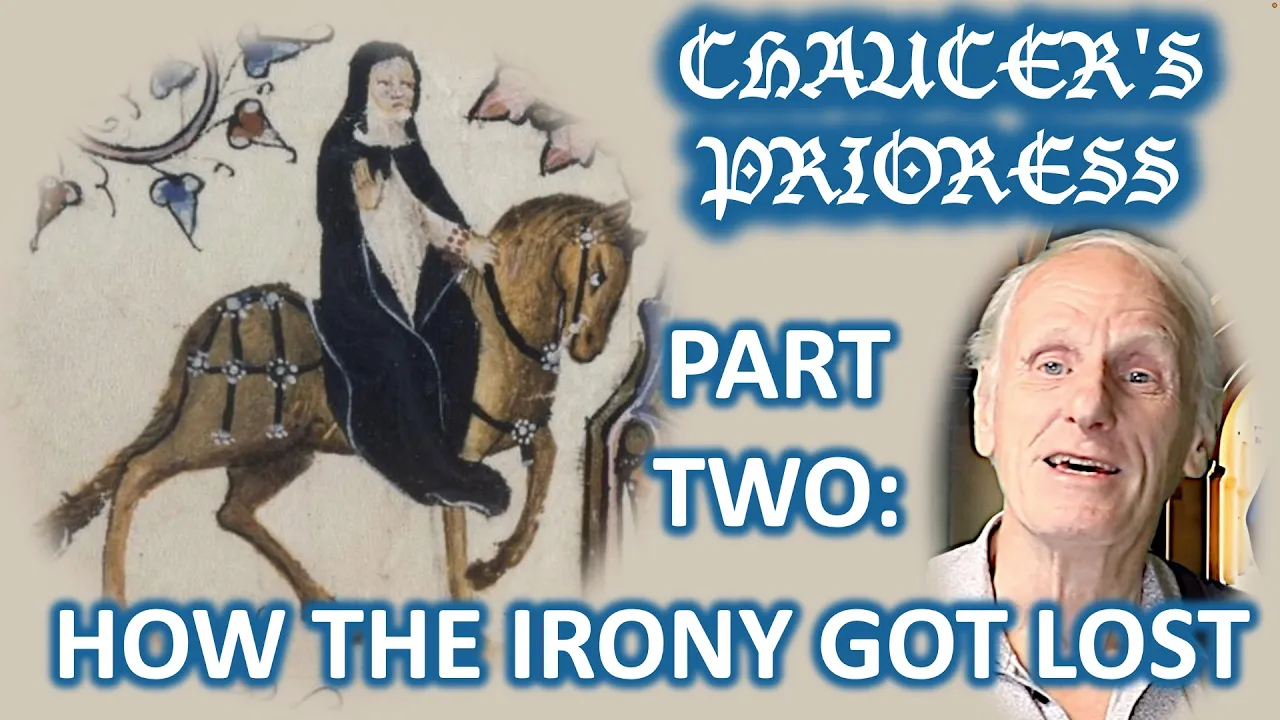
Chaucer, Canterbury Tales: The Prioress PART TWO How Chaucer's ironic intent got lost over the years
https://youtu.be/gzHm-AOlhCk
In Part One, ...I unpacked exactly how ironic Chaucer's portrait of Madame Eglantyne really is. In this video, I trace how that irony got lost over the years.
The story runs through five stages: the disappearance of Chaucer's monastic world after the Reformation, his rebranding as a proto-Protestant (helped along by some outright fabrications about his life), the role of later translations in reshaping his religious satire, Gothic Romanticism's rose-tinted medievalism, and Victorian society's blurring of piety with the performance of piety.
This video focuses on the first three, including a close look at one particular eighteenth-century translation that is central to the topic, but has, I think, been seriously underrated in modern scholarship.
📖 Click here for the full five-part story, with sources and details: https://educationalhub.org/chaucer-irony-prioress-flipbook/
And remember, if you haven't seen the companion video to this one yet, it's here: https://youtu.be/gzHm-AOlhCk
0:00 Recap – irony in Chaucer's Prioress
1:05 How Chaucer's irony got lost for centuries
1:16 The five-part story, overview
3:13 The Reformation & the end of monastic life
4:15 Chaucer recast as a proto-Protestant
5:30 The false Lollard texts attributed to Chaucer
6:49 Speght's invented biography of Chaucer
7:58 Dryden: seeing the irony, then omitting it
8:55 Ogle's 1741 edition & the mystery translator
9:31 Pope's Prioress, presented "straight"
11:08 Did Pope miss the irony or hide it intentionally?
12:34 Whitewashing the Prioress, villainising the rest
13:53 How Pope's Prioress won out for 200 years
14:30 What's been overlooked
Credit:
Fantasy Soundscape by Alexander Nakarada | https://creatorchords.com
Music promoted by https://www.chosic.com/free-music/all/
Creative Commons CC BY 4.0
https://creativecommons.org/licenses/by/4.0/
Some of the effects in this video were created with the help of AI tools. The research, scripting, narrative recording, video editing, etc., is entirely my own.
© All rights reservedShow More
2 Comments
Fascinating breakdown of the reception history. The way Speght’s fabricated biography and the attribution of pseudo-Chaucerian Lollard texts completely reshuffled how readers interpreted Madame Eglantyne is such a clear example of historical context overriding authorial nuance. The point about 18th-century translations—especially Pope presenting her portrait straight—really clarifies how the subtle satirical cues were flattened into mere pious admiration for subsequent generations. Looking forward to exploring the companion flipbook for the source details!
Many thanks for the feedback, Charlotte! The big surprise for me was uncovering the role played by the young Alexander Pope in all this. That is something the standard narrative seems to have missed.
The flipbook is also available as a downloadable PDF to logged-in members. Log-in is free.