
Author: Ano Sensei
Format: Video
Related content:
- • You cannot say may you | or can you? Good and bad language teaching | ENGLISH IN CONTEXT (Video)
- • Curated Grammar Livestream: Your Questions Answered (Video Playlist)
- • English in Context: Basic English Grammar (Video Playlist)
- • Curated Grammar Livestream: Your Questions Answered (Video Playlist)
- • Spotlight on English: Advanced English Grammar (Video Playlist)
📚 Part of a series: English in Context: Basic English Grammar
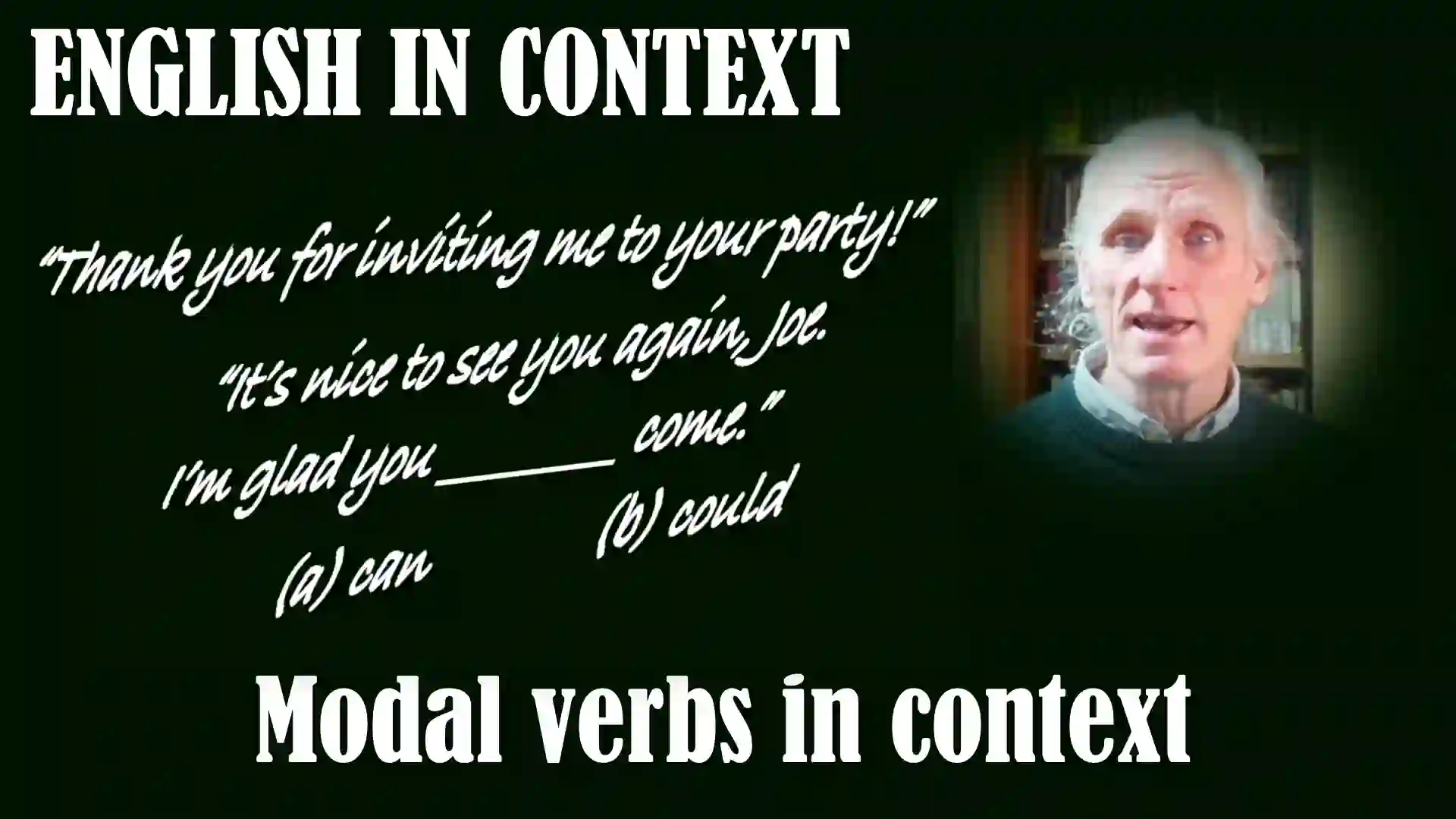
🧑🎓 "I'm glad you can come" or "I'm glad you could come"? ENGLISH IN CONTEXT 👀
In this video I look at the context behind "can" and "could" in a very common social exchange — and at a broader principle that matters for both learners and teachers: a grammatically correct expression is never simply "wrong". It may be unsuitable in a particular context, but that's a very different thing, and the distinction matters.
There's also a bonus point for teachers: the video touches on the common textbook rule that "could" can only be used for general past ability, and "was/were able to" is required for ability on one specific occasion. The expression "I'm glad you could make it" shows clearly why that rule is an oversimplification.
What this video covers:
"Can" vs "could" in social invitations — what's the actual difference?
Why the timing of the conversation determines which form to use
Why teachers should be cautious about labelling grammatically correct expressions as "wrong"
Why the "could vs was/were able to" rule is more complicated than textbooks suggest
I'm John R. Yamamoto-Wilson — formerly Professor of English Literature at Sophia University, Tokyo, with a PhD from the University of Cambridge. These videos are aimed at intermediate learners of English, and at the teachers who work with them. 📌 Part of the English in Context series — intermediate grammar points that textbooks often explain poorly or get wrong. Click here for the complete series: https://www.youtube.com/playlist?list=PLzVb6yL_jY6_sKngAN_gYB8w-KC20AGP4
© All rights reservedShow More